
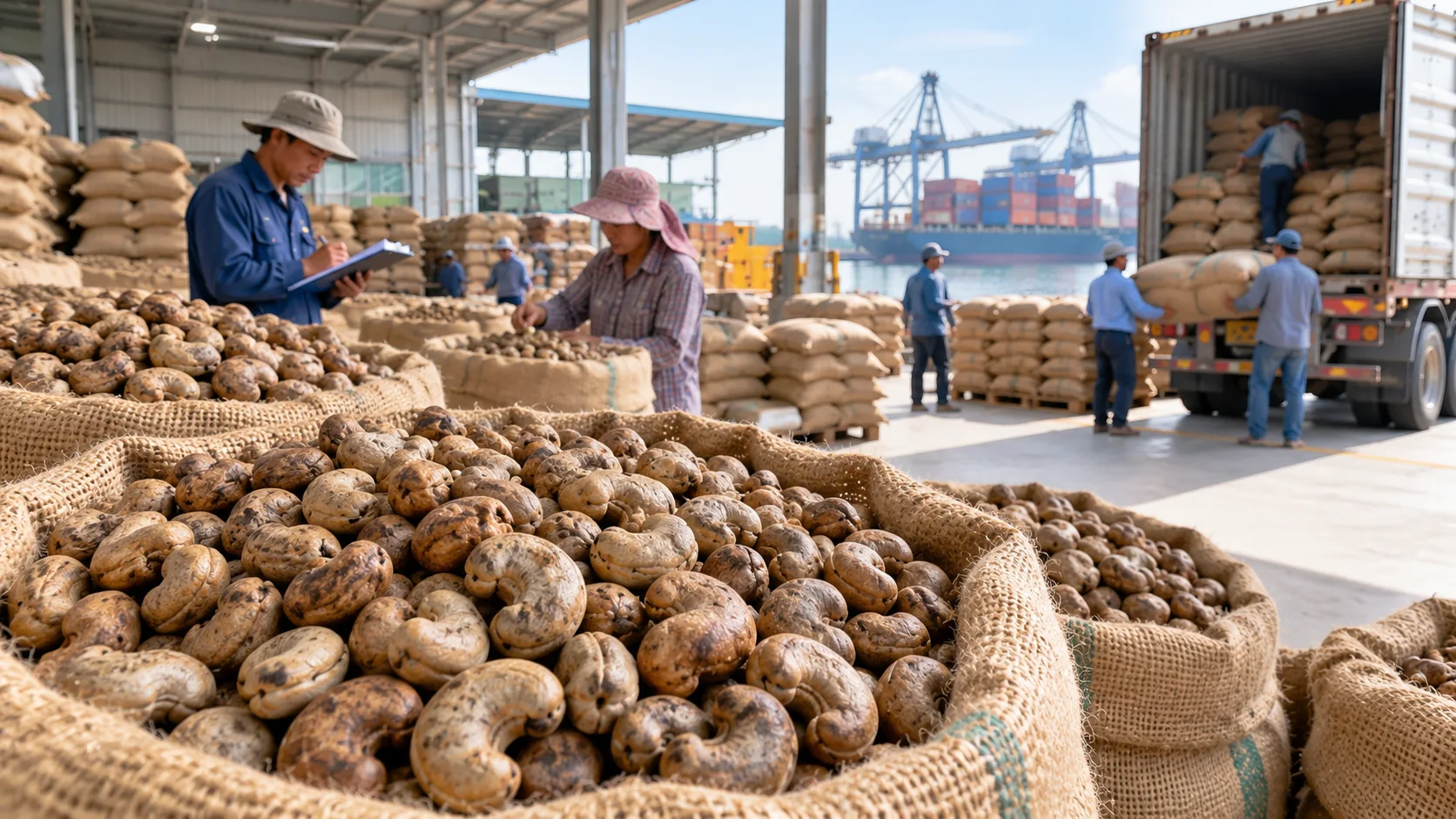
Cambodia remains central to Vietnam’s raw cashew nut (RCN) supply chain, but recent market reporting illustrates how the mix of supplying countries changes over the course of the harvest and trading year.
Cambodia’s strong position through mid-July
According to Vietnam customs figures cited by the Cashew Nut Association of Cambodia (CAC), Cambodia accounted for 54.2% of Vietnam’s cumulative raw cashew import volume as of 15 July 2026. Vietnam had imported approximately 980,700 tonnes of Cambodian raw cashew nuts worth more than US$1.7 billion by that date. These figures describe cumulative imports through mid-July, not a single month’s purchases.
CAC also reported that Cambodia exported approximately 1.03 million tonnes of raw cashew nuts in the first half of 2026, with most shipments destined for Vietnam. The two figures use different reporting periods and should not be treated as interchangeable.
African suppliers gain share later in the season
The sourcing mix looked different in August. Market analysis by Cornhouse estimated that Cambodia supplied 29,354 tonnes, or 8.76% of Vietnam’s raw cashew imports that month. Côte d’Ivoire led August shipments with 118,534 tonnes (35.37%), followed by Nigeria, Ghana and Guinea.
The contrast between 54.2% through mid-July and 8.76% in August does not mean Cambodia lost the same share of the full-year market. One figure is cumulative and the other is monthly. The change is consistent with seasonal shifts in harvest availability and shipping schedules.
Price and quality still matter
CAC’s 18 October analysis notes that Vietnamese processors assess different origins using factors including kernel outturn ratio (KOR), nut count, purchase prices and total landed costs. Supply from Cambodia can provide nearby sourcing options, while African origins may become more prominent as seasonal availability changes. Differences in quality, transport and contract terms mean there is no single price effect across all African suppliers.
What this means for Cambodia
For Cambodian farmers, traders and processors, the figures underscore the importance of reliable drying, moisture control, grading, traceability and market information. Buyers’ needs can change throughout the year, and comparing offers requires attention to quality specifications as well as quoted prices.
For Cambodia’s wider cashew industry, the development also reinforces the opportunity to expand domestic processing and value addition rather than relying solely on raw nut exports. This is a longer-term industry consideration, not a direct prediction of farm-gate prices.
Image note: The accompanying hero image is AI-generated for illustration and does not depict a specific real warehouse or shipment.
Sources: CAC market analysis, 18 October 2026; VnExpress, 2 August 2026; Cornhouse Vietnam Cashew Market, August 2026.