
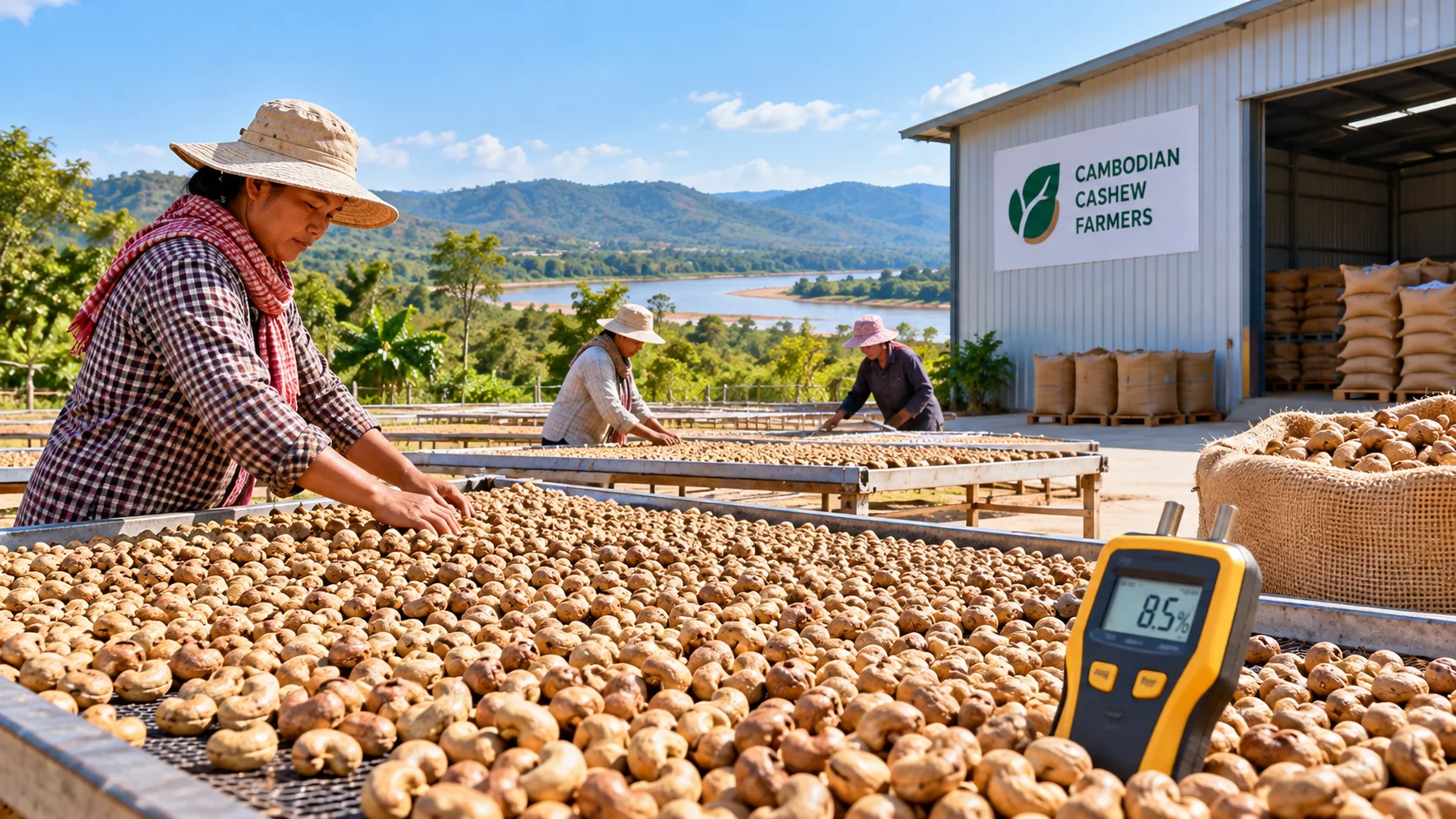
Japan has committed US$164,269 in grant assistance to improve post-harvest cashew handling in Cambodia’s Kratie province, supporting agricultural cooperatives with new storage facilities, drying areas and moisture-testing equipment.
The grant agreement was signed on 2 October 2026 under Japan’s Grant Assistance for Grassroots Human Security Projects, commonly known as KUSANONE. The initiative is expected to benefit approximately 500 members of three agricultural cooperatives.
Japan Supports Three Agricultural Cooperatives
The agreement was signed by Takahito Misumi, Charge d’Affaires ad interim of the Embassy of Japan in Cambodia, and Try Sopheak, Director of the Kratie Provincial Department of Agriculture, Forestry and Fisheries.
According to the reported project details, the grant will support the construction of three storage and drying facilities and the provision of three moisture-measuring devices for three agricultural cooperatives in Kratie province.
The facilities are intended to improve the handling of cashew nuts after harvesting and increase the volume of nuts suitable for sale.
Improving Drying and Storage Conditions
Post-harvest management is an important stage in the cashew value chain. Once raw cashew nuts are harvested, appropriate drying, moisture monitoring and storage practices help maintain quality before processing or sale.
Drying facilities can provide farmers with more organized areas for reducing moisture, while storage facilities can help protect dried nuts from unsuitable conditions.
Moisture-measuring equipment also allows farmers and cooperative operators to assess moisture levels rather than relying solely on visual inspection or experience.
These practices can help reduce the risk of deterioration and support more consistent raw-material quality.
Potential Benefits for Cashew Farmers
The project is expected to support approximately 500 cooperative members by improving access to shared post-harvest infrastructure.
Improved facilities may help farming communities manage their harvests more effectively, preserve product quality and prepare raw cashew nuts for buyers and processors.
However, the longer-term benefits will depend on effective facility management, equipment maintenance, technical training and continued adoption of appropriate post-harvest practices.
Strengthening Cambodia’s Cashew Value Chain
Cambodia’s cashew industry depends not only on production volumes but also on the quality of raw materials entering the processing and export supply chain.
Improving drying, moisture control and storage at the cooperative level can contribute to more reliable supplies for domestic processors.
Such investments also highlight the importance of agricultural infrastructure in strengthening the competitiveness of Cambodia’s cashew sector.
Mato Cashew Perspective
For Mato Cashew, this initiative highlights an essential principle: quality cashew processing begins with proper post-harvest management.
Investments in drying facilities, moisture measurement and storage can strengthen the foundation for higher-quality raw cashew nuts.
Continued cooperation among farmers, agricultural cooperatives, processors and development partners will be important for building a stronger and more sustainable Cambodian cashew industry.
Sources: Cashew Nut Association of Cambodia (3 October 2026); Cambodianess (3 October 2026).
This article is an independent news and industry summary prepared by Mato Cashew. The project details are based on published reports, while the discussion of post-harvest practices and potential benefits represents general industry analysis. The accompanying illustration is AI-generated and does not depict the actual project facilities or beneficiaries.