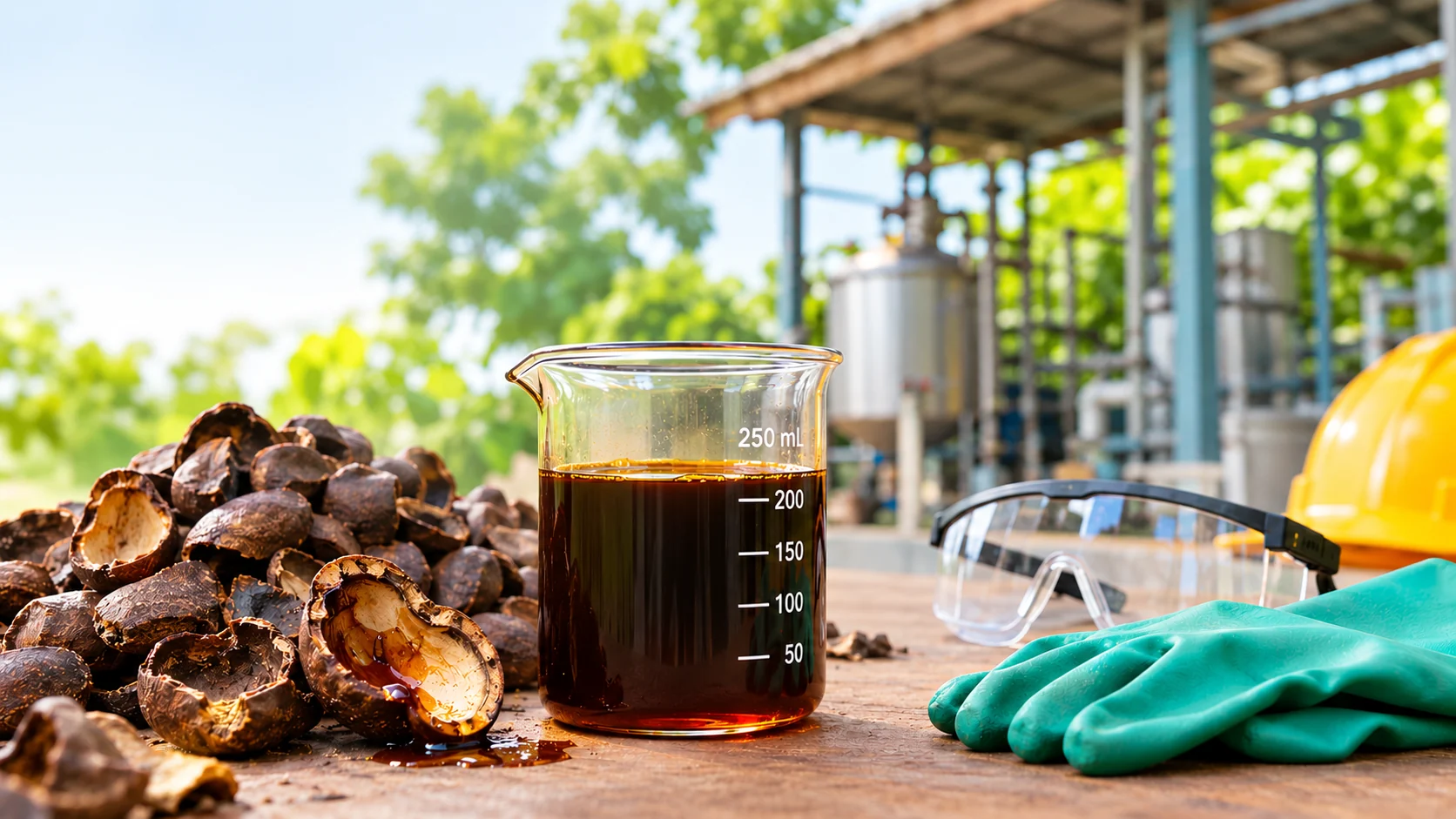
- ✓CNSL is a non-edible phenolic liquid in cashew nut shells.
- ✓Natural and technical CNSL differ because heating changes composition.
- ✓Keep shell residues away from edible kernels and food-handling areas.
- ✓Use trained specialists for industrial extraction and exposure controls.
- ✓Confirm buyer specifications and costs before investing in recovery equipment.
Cashew processing produces more than edible kernels. The shell left after shelling contains cashew nut shell liquid (CNSL), a dark, viscous, non-edible material with potential industrial value. Recovering value from shells can be attractive, but CNSL contains phenolic substances that may injure skin and eyes. Responsible handling comes before commercialization.
1. What is CNSL?
CNSL occurs in the porous, honeycomb-like layer of the cashew nut shell surrounding the edible kernel. Its important constituents include anacardic acids, cardanol, cardol, and smaller amounts of 2-methylcardol. Their relative amounts depend on the raw material and how the liquid is recovered. Because CNSL is not food-grade cashew oil, it must never be confused with edible kernel products.
2. Natural CNSL and technical CNSL
| Feature | Natural CNSL | Technical CNSL |
|---|---|---|
| Typical recovery | Relatively low-temperature extraction | Recovery or treatment involving substantial heat |
| Common major constituent | Anacardic acids | Cardanol, following thermal decarboxylation |
| Composition | Sensitive to extraction conditions | Sensitive to heating history and process controls |
| Commercial implication | May suit composition-specific applications | Often used as an industrial chemical feedstock |
| Quality control | Confirm chemical profile by laboratory analysis | Confirm chemical profile by laboratory analysis |
Natural and technical CNSL are not automatically interchangeable. Published composition ranges vary; buyers may require a specific cardanol content, acidity, water content, or impurity profile.
3. Where CNSL enters the processing workflow
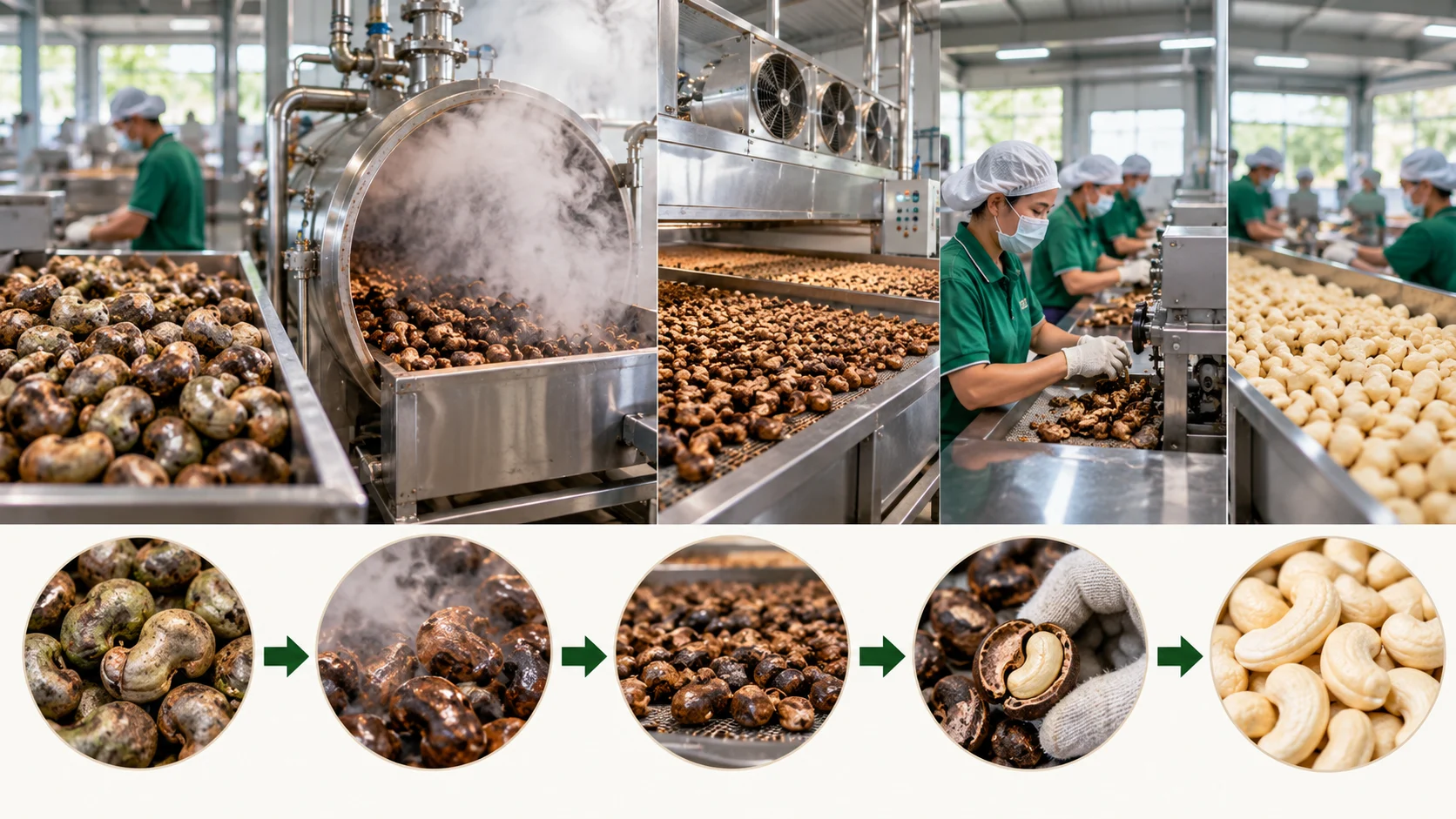
Raw nuts are dried and stored, then treated and shelled to recover the kernels. The discarded shell fraction may retain CNSL. The amount and condition of that fraction depend on the shelling process and earlier heat treatment. Collect shells separately from kernels, food packaging, and ordinary waste. Label containers and keep handling areas organized to reduce accidental exposure.
4. Industrial recovery approaches
| Approach | General principle | Key limitations and controls |
|---|---|---|
| Mechanical | Pressing or mechanical separation of shell liquid | Variable recovery; equipment and worker protection |
| Thermal | Controlled industrial heating releases or transforms shell constituents | Heat, emissions, fire hazards, and chemical changes |
| Solvent-based | Solvents recover selected constituents under controlled conditions | Solvent exposure, recovery systems, and waste management |
| Research-stage methods | Specialized or assisted extraction investigated in studies | Scale-up, economics, and reproducibility require validation |
The extraction route influences both yield and composition. These are high-level descriptions, not instructions for untrained or home-scale extraction. Open burning, improvised heating, and uncontrolled solvent use are unsafe substitutes for properly engineered industrial equipment.
5. Worker safety and storage
CNSL-containing shells and residues can irritate or burn skin and may injure eyes. A facility should carry out a documented hazard assessment and establish practical controls:
- Separate shell collection and storage from edible-kernel processing.
- Use closed or clearly marked containers and prevent leaks or spills.
- Select suitable chemical-resistant gloves, eye protection, protective clothing, and ventilation according to the actual exposure assessment and supplier safety data.
- Provide washing facilities, staff training, spill-response procedures, and appropriate first-aid arrangements.
- Do not discharge liquid or contaminated wash water into drains or surface water; avoid uncontrolled burning.
Where industrial extraction is considered, engage qualified technical and environmental specialists. PPE alone is not a substitute for engineered controls.
6. Industrial applications
CNSL-derived chemicals, especially cardanol, can serve as inputs for resins, coatings, adhesives, surfactants, corrosion-control formulations, and bio-based polymer research. These are industrial feedstocks rather than ready-to-use products. Suitability depends on purification, formulation, specifications, and applicable rules; raw CNSL should not be promoted as a pesticide or direct-use consumer chemical.
7. Business feasibility for Cambodian processors
| Business question | Practical assessment |
|---|---|
| Are shell quantities sufficient? | Record shell output per batch and month; assess seasonal variation |
| Can shells be handled safely? | Review separation, storage, worker exposure, and disposal |
| Is a buyer identified? | Request written specifications, minimum volumes, pricing terms, and testing requirements |
| Would extraction pay? | Estimate equipment, energy, labor, quality testing, environmental controls, and maintenance |
| Could a specialist partner be better? | Explore supplying shells to qualified downstream processors |
| Can traceability be maintained? | Record source batches, storage conditions, and transfers |
A useful first step is a small feasibility study and discussions with credible buyers, not immediate investment in extraction machinery. Industrial demand in Cambodia should be confirmed independently rather than assumed.
8. Environmental management
Shell residues, contaminated absorbents, wastewater, and process emissions can require controlled handling. Prevent runoff and uncontrolled disposal. Follow applicable Cambodian requirements and seek professional advice when handling hazardous process streams. A by-product recovery project is not automatically environmentally beneficial: energy consumption, emissions, and waste treatment matter too.
9. Simple monitoring records
Maintain a dated log of raw nut input, shell output, storage location, incidents, staff training, transfers to buyers, and waste handling. Such records support traceability, negotiations, and safer operations. Any claimed CNSL yield should be based on measured recovery under defined conditions rather than a generic industry estimate.
10. Key takeaways
| Principle | Practical message |
|---|---|
| Value addition | Shells can become a potential industrial feedstock |
| Chemistry | Natural and technical CNSL have different profiles |
| Safety | Prevent contact and control exposure |
| Technology | Recovery requires appropriate industrial systems |
| Market | Verify specifications and buyer demand before investing |
| Environment | Assess the full process, not only potential revenue |
Conclusion
CNSL offers a possible route to greater value from cashew processing by-products. For many small and medium processors, the sensible starting point is to measure shell volumes, separate shells from food operations, protect workers, and explore qualified downstream buyers. Any move into recovery or refining should follow a technical, financial, safety, and environmental assessment.
Further reading
- FAO, Minor Oil Crops — Cashew Nut (technical reference; publication date not specified on linked page): https://www.fao.org/4/X5043E/x5043E06.htm
- Discover Applied Sciences (2024), CNSL review: https://doi.org/10.1007/s42452-024-06258-6
- Scientific Reports (2025), research on shell pretreatment and extraction: https://doi.org/10.1038/s41598-025-03071-y
Educational information only. Industrial handling and extraction require site-specific risk assessment and qualified oversight.