Cashew Steaming and Drying
Steaming and drying are important stages between raw cashew nut preparation and shelling. They should not be viewed simply as heating and drying operations. During these stages, heat and moisture move through the nut, shell, and kernel, changing the condition of the material that later enters the shelling process.
Recent research provides useful insight into how water and water vapor move during soaking, steaming, and drying and why moisture management deserves attention in cashew processing.
Quick Facts
- ✓Recent research examined heat and mass transfer in cashew nuts during soaking, steaming, and drying.
- ✓The study identified the hilum region as an important pathway in moisture transfer.
- ✓Steaming and drying change the moisture condition of the nut before shelling.
- ✓Raw-nut moisture and finished-kernel moisture describe different processing stages and should not be treated as the same specification.
- ✓Processors can improve process understanding by recording moisture and processing conditions for each batch.
What the Research Says
A 2026 study by Diallo and colleagues investigated heat and mass transfer in cashew nuts during steaming and drying operations.
The researchers examined the movement of liquid water and water vapor during soaking, steaming, and drying. Their work identified an important moisture-transfer pathway associated with the hilum of the cashew nut.
The researchers also developed a two-compartment model to describe the transfer processes observed in the nut.
This research is useful because shelling performance depends not only on the shelling machine itself. The physical condition of the nut entering the shelling stage is also influenced by the treatments applied beforehand.
Source Finding vs Practical Interpretation
The findings above describe the research. Recommendations for factory monitoring and batch records below are practical interpretations by Mato Cashew and should not be presented as operating limits established by the study.
Why Moisture Management Matters Before Shelling
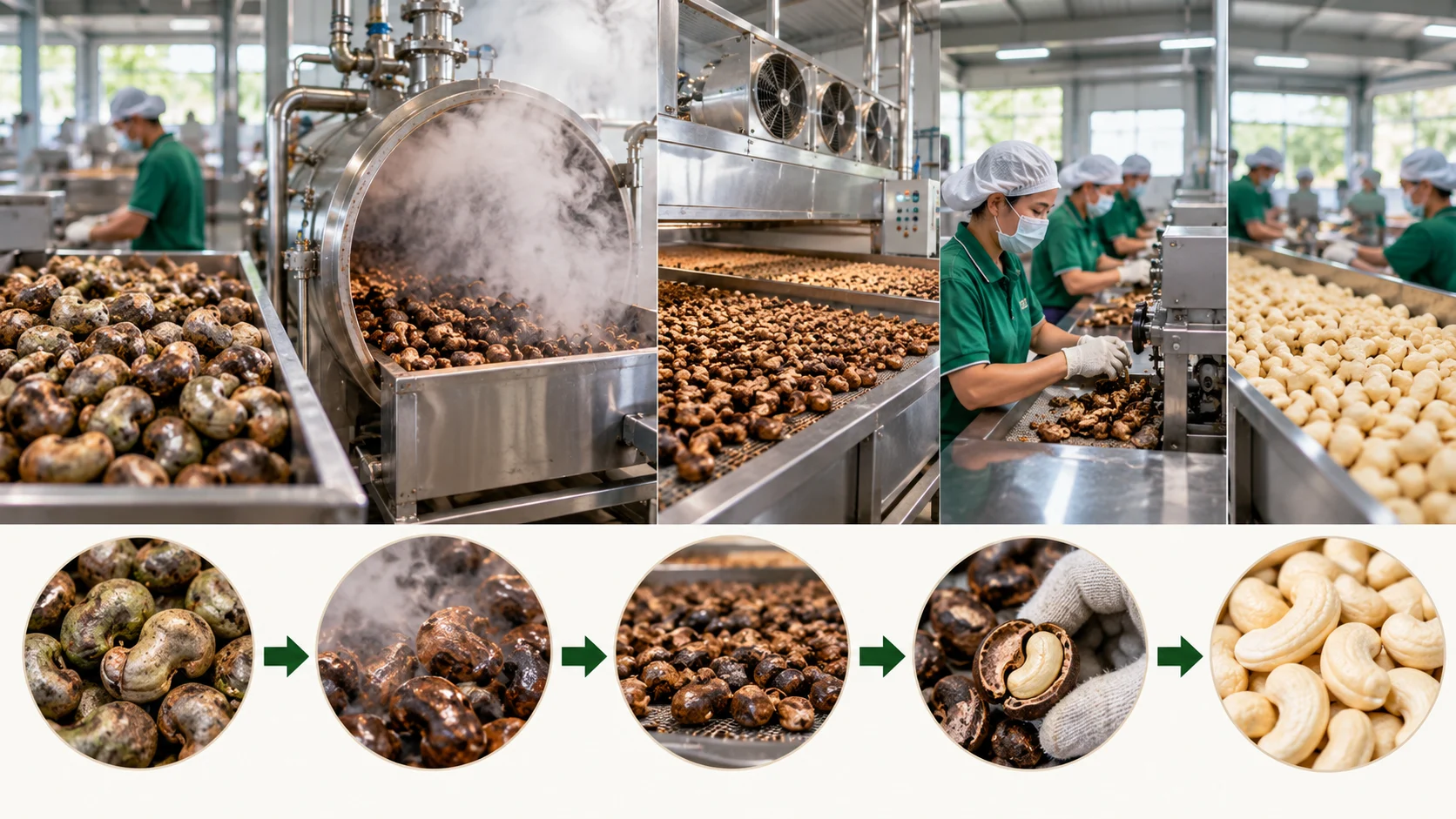
The cashew processing sequence can be simplified as:
Raw cashew nut → preparation or conditioning → steaming → drying or resting → shelling → kernel drying → peeling → grading
Steaming introduces heat and changes the moisture condition of the nut. Subsequent drying or conditioning changes that condition again before shelling.
For this reason, processors should consider the stages as a connected process rather than treating each machine or operation independently.
The objective is not simply to make the nut “wet” or “dry.” The important question is whether the material reaches a suitable and repeatable condition for the next processing operation.
Do Not Confuse Raw-Nut and Finished-Kernel Moisture
Moisture values reported for raw or pre-shelling cashew nuts cannot automatically be compared with commercial moisture specifications for finished kernels.
These measurements relate to different materials and different stages of production.
For example, the Mato Cashew guide on finished-kernel moisture discusses AFI and UNECE specifications. Those finished-product specifications should not be applied directly as steaming or pre-shelling operating targets.
Identify the Processing Stage
Whenever a moisture percentage is reported, first identify whether the sample is a raw cashew nut, conditioned nut, pre-shelling nut, dried kernel, or finished kernel.
Practical Application for Cambodian Processors
The following points are practical recommendations for process monitoring. They are not numerical operating specifications from the 2026 study.
1. Record Raw Material Characteristics
For each batch, processors can record:
- supplier or source;
- raw cashew nut grade or size;
- initial moisture reading, where an appropriate method is available;
- receiving date; and
- important observations about raw-material condition.
2. Record Steaming Conditions
A batch record can include:
- batch identification;
- steaming time;
- process condition used by the factory;
- start and finish time; and
- operator observations.
3. Record Drying or Resting Conditions
Processors can also document:
- drying or resting duration;
- drying method;
- relevant environmental or equipment conditions; and
- moisture measurement where appropriate.
4. Compare the Result After Shelling
The processing record becomes more useful when it is connected with production results such as:
- whole kernels;
- broken kernels;
- shelling rejects;
- difficult-to-shell nuts; and
- other quality observations.
Over time, this information can help a processor understand which combinations of raw material and processing conditions are associated with more consistent results.
Application to Small-Scale Processing
Small processors do not necessarily need an advanced digital system to begin process monitoring.
A simple batch sheet can record:
Raw material → size/grade → initial condition → steaming → drying/resting → shelling → whole kernels → broken kernels → rejects
Once enough batches have been recorded, the processor can compare results rather than relying only on operator memory.
This approach can also support future decisions about equipment settings, worker training, raw-material segregation, and quality-control procedures.
Important Limitation
The research discussed here improves understanding of moisture and heat transfer during cashew processing. It does not establish one universal steaming time, drying time, temperature, or moisture target suitable for every cashew variety, nut size, machine, factory, and climate.
Processors should validate operating conditions for their own raw material, equipment, food-safety system, and buyer requirements.
Sources
Primary research
Diallo et al. (2026). Experimental study and modelling of heat and mass transfers in cashew nuts during steaming and drying operations.
FAO AGRIS record:
https://agris.fao.org/search/es/records/6a96d7348a202ccda1b659cb
Technical reference
Food and Agriculture Organization of the United Nations (FAO). Technical information on cashew processing and post-harvest handling.
FAO:
https://www.fao.org/
Key Takeaway
Steaming, drying, and shelling should be managed as connected processing stages. Recent research improves understanding of how moisture moves through cashew nuts during these operations.
For Cambodian processors, one practical step is to build reliable batch records linking raw-material condition and processing parameters with whole-kernel, broken-kernel, and reject results.
This turns daily production experience into information that can support continuous process improvement.