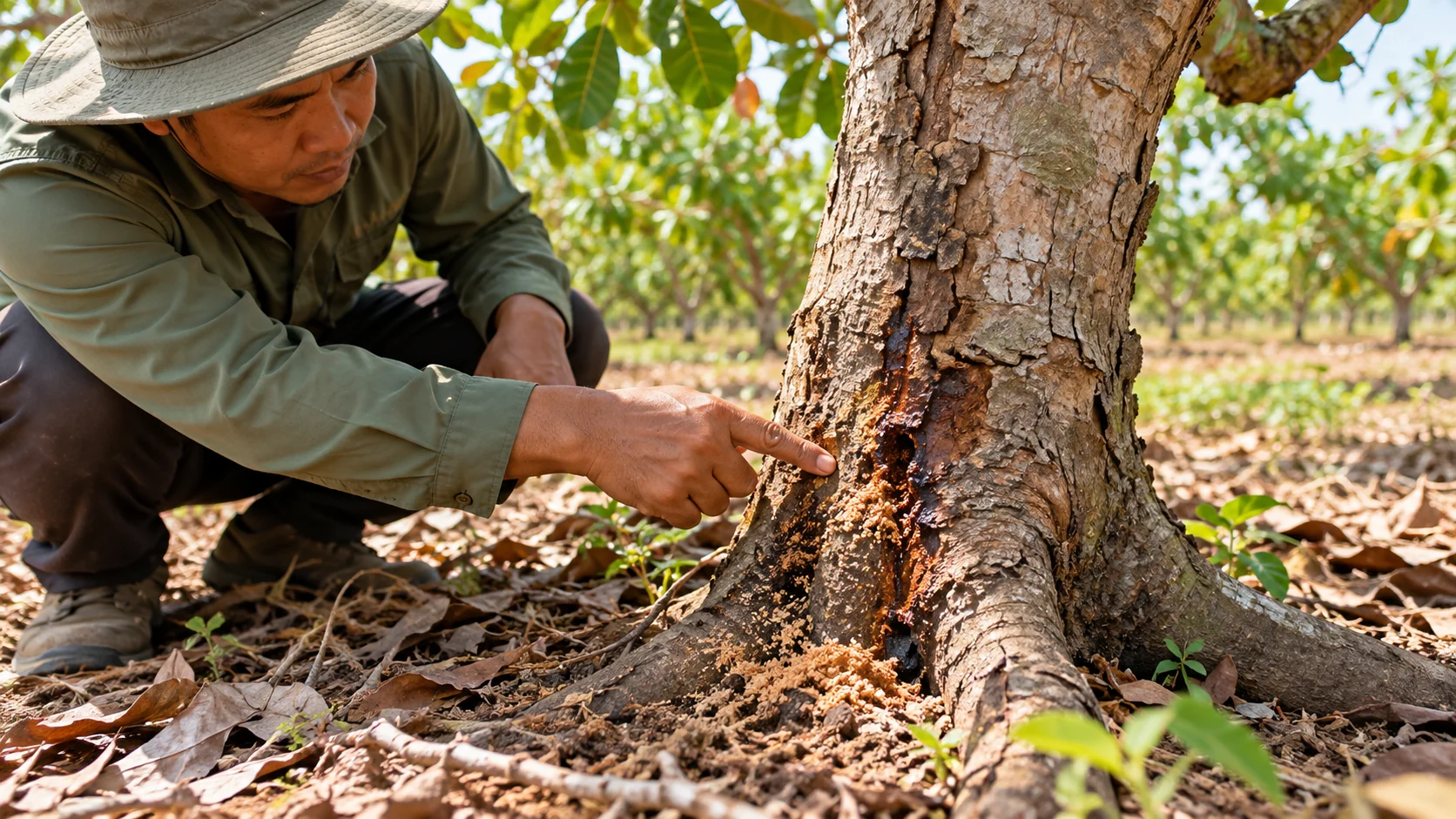
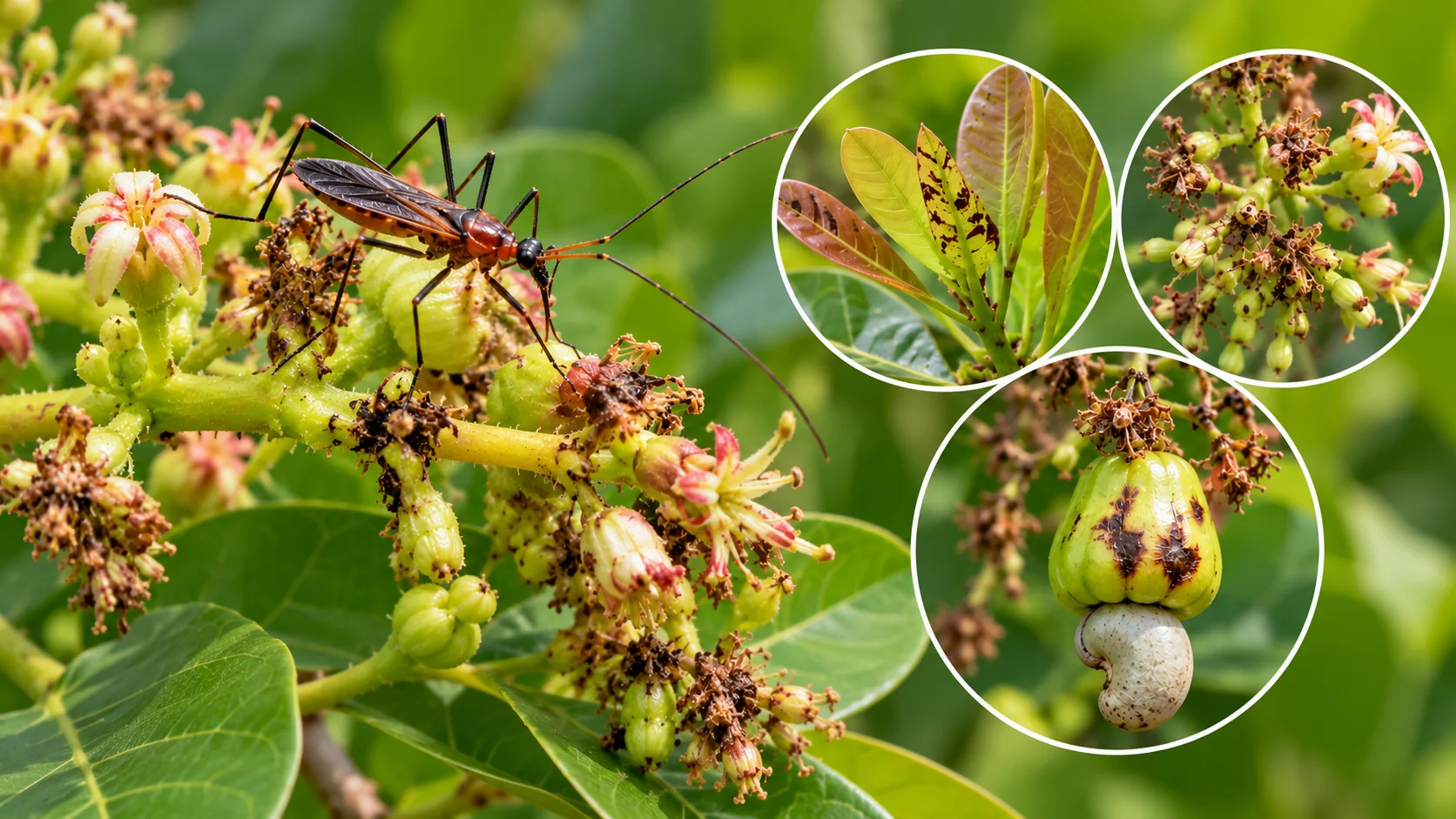
Tea mosquito bug (TMB), particularly Helopeltis antonii, is one of the important insect pests affecting cashew production. Despite its common name, it is not a mosquito. It is a sap-feeding insect that attacks young and tender parts of the cashew tree.
The pest deserves particular attention because its population can increase during important crop-development stages, including new flushing, flowering and nut formation. Damage during these stages can weaken young shoots, affect flowers and developing nuts, and ultimately reduce productivity.
🐞 How Tea Mosquito Bug Damages Cashew
Tea mosquito bugs feed by piercing tender plant tissues and sucking sap. Their feeding can produce dark or necrotic lesions on young shoots, flower panicles and developing fruits.
When attacks are severe, tender shoots may dry back, flower panicles can become damaged, and fruit or nut development may be affected. This makes early detection especially important.
Farmers should therefore pay close attention to new flushes and flowering panicles rather than waiting until widespread damage is visible throughout the orchard.
🔍 The Most Important Time for Monitoring
Research on tea mosquito bug management indicates that three cashew growth stages require particular attention:
🌱 1. New Flushing
Young shoots provide tender tissues suitable for pest feeding.
🌼 2. Flowering
Damage to flower panicles during this stage may directly affect potential nut production.
🌰 3. Nut Formation
Young developing fruits and nuts remain vulnerable to feeding damage.
Regular field observation during these periods allows farmers to identify infestation earlier and decide whether management measures are necessary.
🌿 Can Plant-Based Treatments Help?
Recent research provides encouraging evidence for botanical pest-management approaches.
A 2025 field study conducted at the Regional Research Station in Vridhachalam, Tamil Nadu evaluated seven botanical treatments against tea mosquito bug in cashew.
The researchers applied treatments at critical stages of flushing, flowering and nut formation. The study found a significant reduction in tea mosquito bug incidence in plots treated with botanical pesticides compared with the untreated control.
Among the treatments evaluated, a mixture of plant extracts containing neem (Azadirachta indica) together with several other botanical materials showed strong effectiveness. Pongamia oil at the concentration evaluated in the experiment also performed well.
These findings suggest that botanical pesticides may have a useful role in reducing reliance on conventional synthetic pesticides as part of a broader pest-management strategy.
🛡️ Botanical Control Should Be Part of IPM
Botanical pesticides should not be viewed as a single solution for every orchard.
A stronger approach is Integrated Pest Management (IPM), combining several practices:
- Regular orchard monitoring, particularly during flushing and flowering.
- Early identification of fresh feeding damage.
- Good orchard sanitation and removal of severely damaged plant material where appropriate.
- Maintenance of suitable canopy conditions through good orchard management.
- Protection of beneficial organisms and natural enemies.
- Use of botanical or other approved crop-protection products when intervention is justified.
- Rotation and responsible use of control methods to reduce unnecessary pesticide pressure.
The objective is not simply to spray more frequently. It is to detect the pest early and use the most appropriate intervention at the correct crop stage.
⏱️ A Practical Lesson for Cashew Growers
For growers, the most important lesson is timing.
Tea mosquito bug management should begin with observation before serious damage occurs. Farmers should increase monitoring when trees begin producing new shoots and continue through flowering and early nut development.
Fresh damage on young shoots or flower panicles should be investigated promptly.
⚠️ Important Safety Note
Where botanical products are considered, farmers should use properly identified materials and follow locally approved agricultural recommendations. Results obtained from research trials in another country should not automatically be treated as an exact pesticide prescription for Cambodian farms.
🇰🇭 Why This Matters for Cambodia
Cambodia’s expanding cashew sector depends not only on increasing planted area but also on improving productivity and raw-nut quality.
Better pest monitoring can help farmers protect flowers and developing nuts before damage becomes severe. At the same time, research into botanical pest-management methods provides useful knowledge for developing production systems that seek to balance crop protection, farmer safety, environmental considerations and economic sustainability.
For Cambodian conditions, additional local field trials would be valuable to determine which botanical treatments, concentrations and application schedules are both effective and practical.
📚 Research Source
This article draws on a 2025 field study on botanical management of tea mosquito bug in the cashew ecosystem, together with broader cashew crop-protection guidance. The research findings are presented as educational information and should be interpreted in the context of locally approved agricultural practices.
Prepared for: Mato Cashew — Knowledge Center