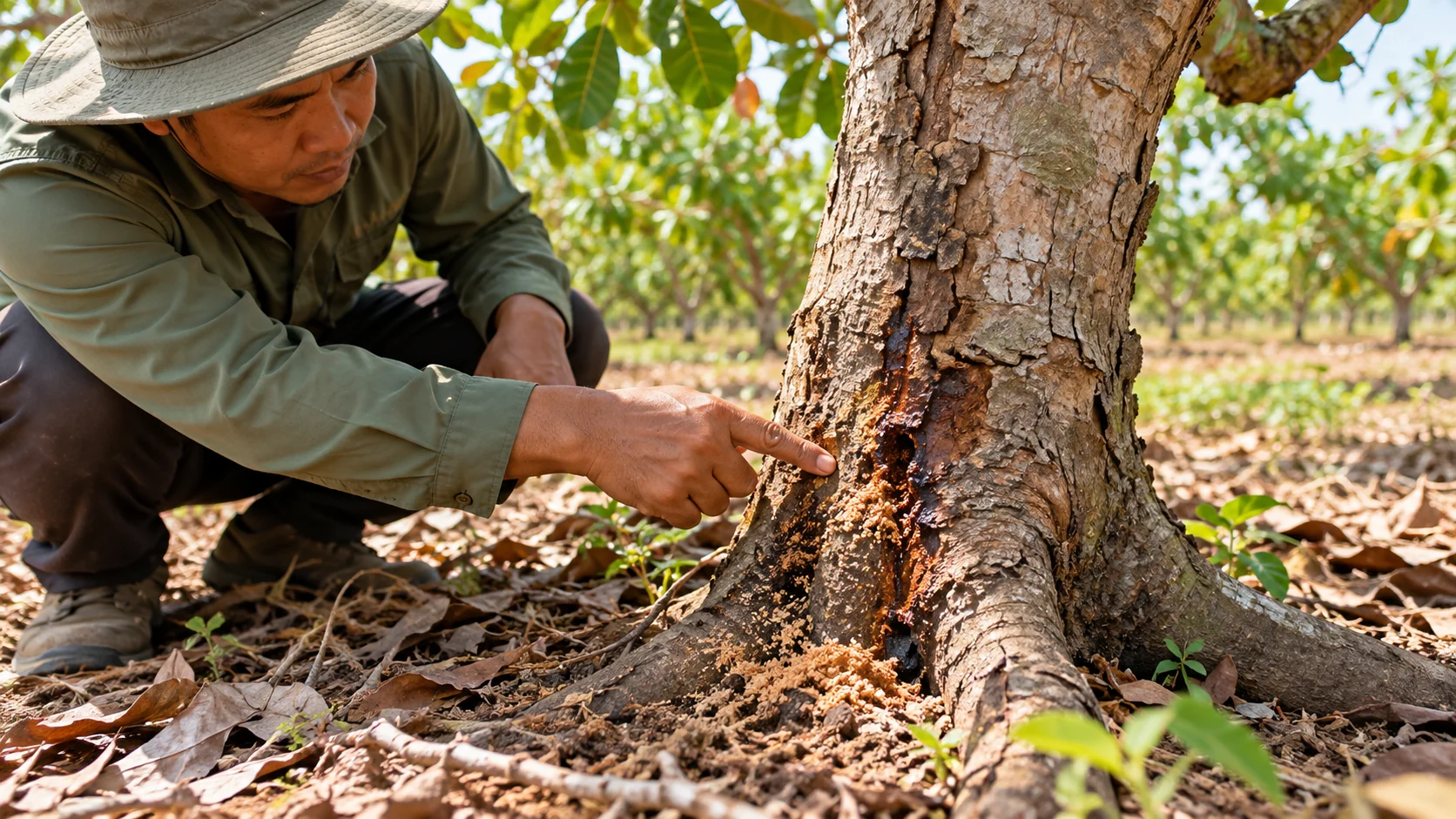
- ✓Inspect the lower trunk, root collar and exposed roots for fresh frass and gum.
- ✓Leaf yellowing alone does not confirm borer attack.
- ✓Avoid cutting away healthy bark or digging into the trunk without expert guidance.
- ✓Monitor treated trees for renewed activity.
- ✓Follow Cambodian pesticide registration and label requirements.
Cashew (Anacardium occidentale L.) trees can be damaged by wood-boring beetle larvae that feed under bark and within trunk tissues. Because larvae may remain hidden, damage can progress before the canopy shows obvious decline. Early inspection and accurate identification are more useful than waiting for a tree to wilt. This guide draws mainly on Indian cashew research; it does not establish which borer species occur in any particular Cambodian orchard.
1. What are cashew stem and root borers?
Cashew stem and root borer (CSRB) is a practical name for wood-boring beetle pests whose larvae attack the lower stem and sometimes the root-collar region. Indian technical sources discuss Plocaederus ferrugineus (also described in some literature as Neoplocaederus ferrugineus) and other wood-boring beetles associated with cashew. Species identification requires suitable specimens and expert assessment; visible tree symptoms alone are insufficient.
Adult beetles lay eggs in suitable sites on trees. Larvae feed in protected galleries under the bark and may damage living tissues. Advanced injury can interfere with tree function and eventually contribute to branch dieback or tree death.
2. Warning signs and other possible causes
Examine the lower trunk, bark crevices, root collar and any exposed roots for:
- Fresh frass: fibrous or powdery wood debris near holes or at the base of the trunk.
- Gum or sap exudation: sticky material emerging from damaged bark.
- Bark injury or openings: suspicious holes, cracks, loosened bark or galleries.
- Canopy decline: yellowing leaves, drying branches or progressive loss of vigor in advanced cases.
These signs warrant investigation, but no single symptom confirms the species responsible. Drought stress, mechanical injury and root diseases can also cause canopy decline or sap flow. Seek a qualified diagnosis before undertaking destructive treatment.
3. A practical orchard inspection routine
Walk the orchard systematically and check the base of each tree, giving particular attention to trees that were previously affected or are declining unexpectedly. Use a consistent tree identifier and record the inspection date, visible frass, gum, damaged bark and canopy condition. Photograph suspicious areas from the same angle during follow-up visits.
If new frass appears after an earlier inspection, mark the tree for prompt technical assessment. Do not assume that an old hole means larvae are still active; likewise, a tree with few external signs may still need investigation if it is declining.
4. Prevention and orchard hygiene
Protect trunks from unnecessary wounds caused by cutting equipment or careless field operations. Maintain access to the base of trees for inspection and promptly assess severely weakened or dead trees. Handle suspected infested wood according to local technical advice so that disposal does not spread pests or create new hazards.
General tree care, appropriate water and nutrient management, and attention to other stresses support orchard health but do not guarantee prevention of wood-borer attack.
5. Responding to a confirmed infestation
Indian cashew guidance describes careful physical removal of accessible larvae as one management option. Such work can damage living bark and conductive tissues if carried out improperly. Do not strip bark around the trunk, excavate deeply or apply improvised chemicals into holes without competent supervision.
A trained agricultural adviser should assess the extent of damage and whether intervention is feasible. Follow-up inspection is essential because removal of a larva does not automatically prevent reinfestation.
6. Integrated pest management (IPM)
An IPM plan combines early surveillance, sound identification, sanitation, appropriate physical measures and repeated monitoring. Research on post-removal treatments in India can inform scientific discussion but does not prove that the same products, rates or methods are approved or effective in Cambodia.
Use pesticides only when they are registered for the intended use in Cambodia and applied according to their local labels and qualified advice. Do not copy pesticide names, concentrations or application methods from overseas experiments into farm instructions.
7. Research on early detection
A 2022 study explored acoustic methods to detect concealed cashew borer activity. Such methods may help research and diagnosis, but equipment performance under a study’s conditions should not be treated as a validated field accuracy rate for Cambodia. Visual inspection and professional assessment remain important.
8. Deciding whether a tree can recover
Mark trees with suspicious early signs for prompt assessment. For confirmed damage, consider the location and extent of bark injury, canopy condition and whether the tree remains structurally sound. Severely damaged or unstable trees require professional evaluation before removal or further intervention. There is no universal threshold that reliably determines recovery across all orchards.
9. Mistakes to avoid
Avoid diagnosing borers from yellow leaves alone, ignoring fresh frass, removing excessive living bark, applying unregistered pesticides, and assuming a single treatment has permanently solved the problem. Keep records of inspection dates and follow-up observations.
Conclusion
Early recognition of suspicious frass, gum and bark damage near the lower trunk can help growers respond before cashew trees deteriorate further. Inspect regularly, confirm the cause, avoid injuring healthy tissues and seek locally appropriate technical advice. Evidence from other countries should be adapted cautiously rather than presented as verified Cambodian field practice.
References
- ICAR Research Complex for Goa (ICAR-CCARI). Cashew crop management and stem/root borer guidance. Undated technical resource. https://ccari.res.in/dss/cashew.html
- ICAR Directorate of Cashew Research. Cashew Stem and Root Borer. Undated technical guide. https://cashewresearch.in/pestsite/cashew-stem-root-borer/
- Reddy et al. (2025). Study on post-removal management of cashew stem and root borer. Agricultural Science Digest, first published online 11 March 2025. https://arccjournals.com/journal/agricultural-science-digest/D-6098
- Maruthadurai et al. (2022). Research on acoustic detection of cashew stem and root borer. Journal of Asia-Pacific Entomology. https://doi.org/10.1016/j.aspen.2022.101968
- Kerala Agricultural University. Cashew stem and root borer management. Undated extension guidance. https://www.celkau.in/crops/cashcrops/cashew/rootborer.php