- ✓Prune selectively rather than removing as much wood as possible.
- ✓Remove dead, broken and unnecessarily crossing branches.
- ✓Preserve healthy foliage and avoid excessive pruning.
- ✓Adapt timing to the local Cambodian orchard cycle.
- ✓Pruning does not guarantee a specific yield increase.
Cashew (Anacardium occidentale L.) is an important crop for Cambodian farming livelihoods and the processing industry. Orchard care involves more than fertilization and pest control: tree training, selective pruning and canopy management also deserve attention. Crowded, crossing, broken and low-hanging branches can make inspection and harvesting difficult. Effective pruning means removing what is necessary while retaining healthy, productive foliage.
1. Why pruning and canopy management matter
A balanced canopy can improve access to sunlight and make it easier to inspect branches for pests and diseases. Selective pruning can remove dead, broken or rubbing branches and support a more manageable tree structure. However, pruning does not guarantee increased yield. Outcomes vary with variety, age, tree health, pruning intensity and growing conditions.
2. Training young cashew trees
Young trees benefit from early attention to trunk and branch structure. On grafted trees, remove shoots that emerge from the rootstock below the graft union so they do not compete with the selected scion. Retain healthy structural branches with suitable spacing and growth direction.
ICAR technical guidance describes a clear trunk of approximately 0.75–1 metre in certain training systems. This is a reference for suitable orchard systems, not a universal rule for all Cambodian varieties or planting densities. Avoid removing healthy branches without assessing the individual tree.
3. Which branches should be removed?
- Dead or broken branches: Remove carefully to improve safety and orchard access.
- Branches showing disease symptoms: Assess the cause; clean or disinfect tools appropriately when infectious disease is suspected.
- Crossing or rubbing branches: Where necessary, retain the healthier, better-positioned branch and selectively remove the other.
- Low branches interfering with work: Remove only where needed; healthy low branches do not automatically need cutting.
- Rootstock suckers: On grafted trees, remove shoots arising below the graft union.
Inspect the tree from several directions before deciding what to cut.
4. Sunlight and pruning intensity
Leaves need sunlight for photosynthesis. A very dense canopy can shade its inner leaves, but severe pruning can also remove too much photosynthetic area. Research from northeastern Benin found that cashew responses differed according to pruning severity and branch position. More severe pruning is not necessarily better for flowering or fruiting. Begin with dead, damaged and clearly problematic branches instead of removing large amounts of healthy wood.
5. Choosing the right time
Consider the local flowering, fruit-development and harvest calendar. Removing productive shoots during flowering or fruiting can reduce potential crop-bearing growth. After harvest may be an appropriate time to assess maintenance pruning in some Cambodian orchards, provided the tree has adequate moisture and conditions for recovery. Do not apply a pruning month from another country without checking local seasonal conditions.
6. Safe pruning and aftercare
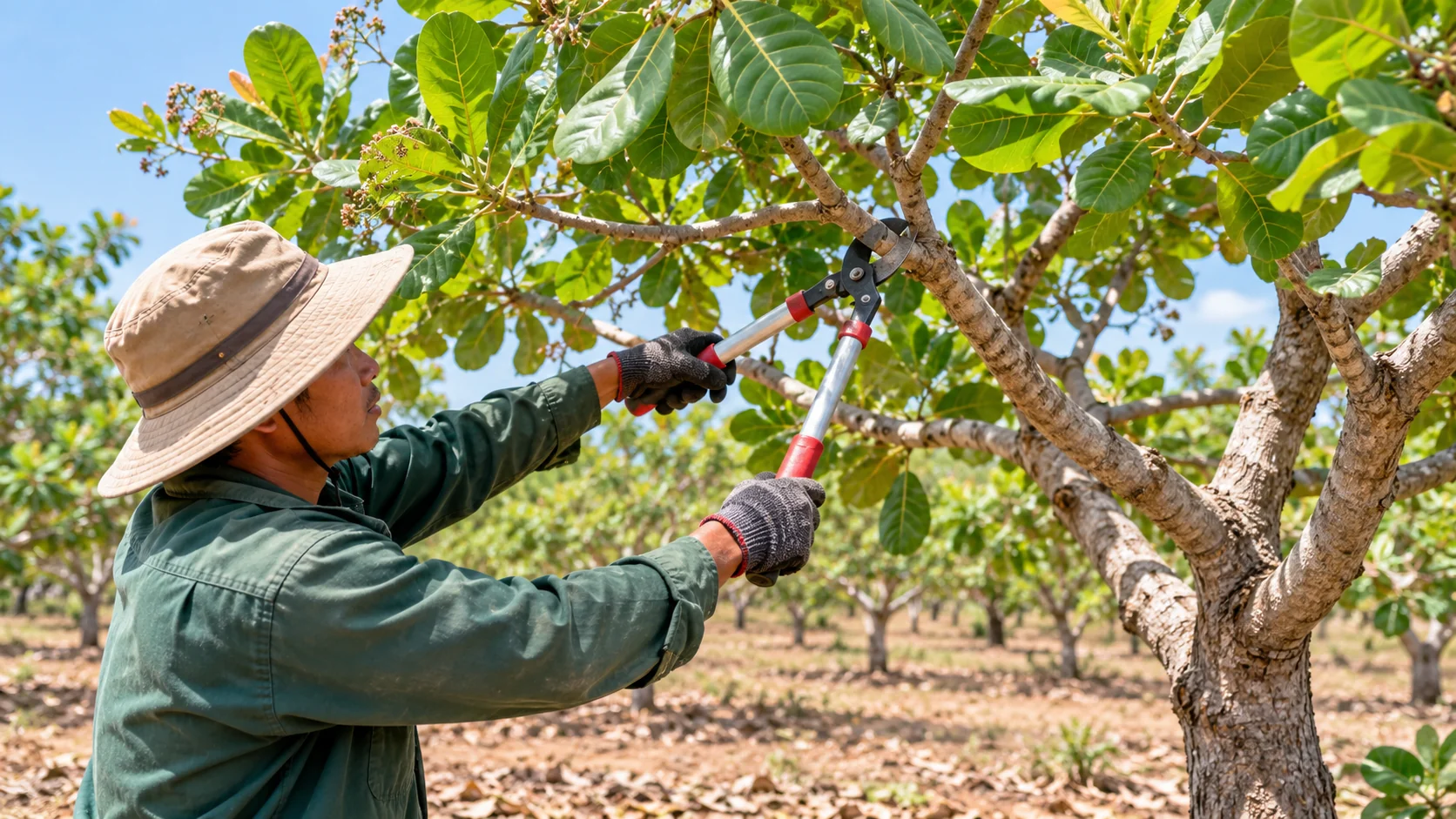
Use sharp, clean pruning shears or saws and appropriate protective equipment. Identify the branch attachment and make a clean cut just outside the branch collar; avoid flush cuts and long stubs. Large branches may need staged cuts to prevent bark tearing. Use trained assistance for high-risk work.
After pruning, monitor new shoots, inspect wounds, handle diseased debris appropriately, and maintain suitable water and nutrient management. Record the pruning date and observations for later comparison.
7. Common mistakes to avoid
Avoid excessive removal of healthy leaves, poorly timed cutting during reproductive growth, dull or contaminated tools, and treating all varieties and ages alike. Removing large branches without adequate skills can injure workers and damage trees.
8. Evaluating results
Record tree age, variety, pruning date, branches removed, shoot regrowth, flowering, fruiting and yield at subsequent harvests. Where possible, compare similar pruned and unpruned trees. Weather, fertilizer, water availability and pest pressure can also affect yield, so do not attribute every difference to pruning.
Conclusion
Selective pruning and early tree training can help maintain healthier tree structure and make orchard management easier. Prune only where needed, preserve productive foliage, and observe how trees respond. Yield improvements are possible under suitable conditions but are not guaranteed.
References
- Adiga, D. J., Veena, G. L., Thondaiman, V., & Babli, M. (2020). An overview of canopy management in cashew (Anacardium occidentale L.). Journal of Horticultural Sciences, 15(2), 127–135. https://doi.org/10.24154/jhs.v15i2.905
- Salifou, A. D., & Akossou, A. Y. J. (2024). Response of the Cashew Tree (Anacardium occidentale L.) to Pruning in Northeast Benin. European Journal of Science, Innovation and Technology, 4(3), 299–317. https://www.ejsit-journal.com/index.php/ejsit/article/view/460
- Desai, A. R., et al. (2010). Techniques and Practices for Cashew Production. ICAR Research Complex for Goa, Technical Bulletin No. 21. https://ccari.res.in/TB%20No.21.pdf