- ✓Sample soil by uniform orchard block and keep different depths separate.
- ✓Interpret soil and leaf tests together with orchard observations.
- ✓Yellow leaves alone do not confirm nutrient deficiency.
- ✓Follow the laboratory protocol for leaf sampling and interpretation.
- ✓Do not copy foreign fertilizer rates without local validation.
Cashew trees can grow on relatively low-fertility soils, but consistent harvests still depend on adequate nutrition. Soil testing and leaf nutrient analysis are complementary tools: the first examines the growing environment, while the second helps assess nutrients accumulated in plant tissue. Neither test alone establishes the cause of poor tree growth.
1. Why test soil and leaves?
Yellow leaves, weak shoots or declining yields may be associated with nutrient limitations, but similar symptoms can arise from drought, waterlogging, damaged roots, pests or diseases. Testing helps avoid unnecessary fertilizer spending and supports comparisons across orchard blocks and seasons.
2. Nutrients cashew trees need
| Nutrient | Main role |
|---|---|
| Nitrogen (N) | Leaf growth and chlorophyll |
| Phosphorus (P) | Energy transfer, root and reproductive processes |
| Potassium (K) | Water regulation and stress response |
| Calcium (Ca) | Cell walls and developing tissues |
| Magnesium (Mg) | Chlorophyll component |
| Sulfur (S) | Protein formation |
| Zinc (Zn) and boron (B) | Enzymes, growth and reproductive development |
| Iron (Fe) and manganese (Mn) | Photosynthesis and metabolism |
A nutrient may be present in soil but unavailable to roots because of pH, moisture, damaged roots or nutrient interactions. The goal is balanced nutrition, not the highest possible application rate.
3. Soil pH and useful laboratory tests
Soil pH affects nutrient availability. Strongly acidic conditions may limit some nutrients and increase the solubility of others. A laboratory may test pH, organic carbon or organic matter, available phosphorus and potassium, and other nutrients according to the local analytical method. Electrical conductivity may be relevant where salinity is suspected. Also observe drainage, compaction, erosion and soil texture.
Do not apply lime simply because a field is assumed to be acidic. Seek a soil-test-based recommendation from a qualified local adviser.
4. Collecting representative soil samples
- Divide the orchard into blocks. Keep different soil types, slopes, drainage conditions, tree ages and fertilizer histories separate.
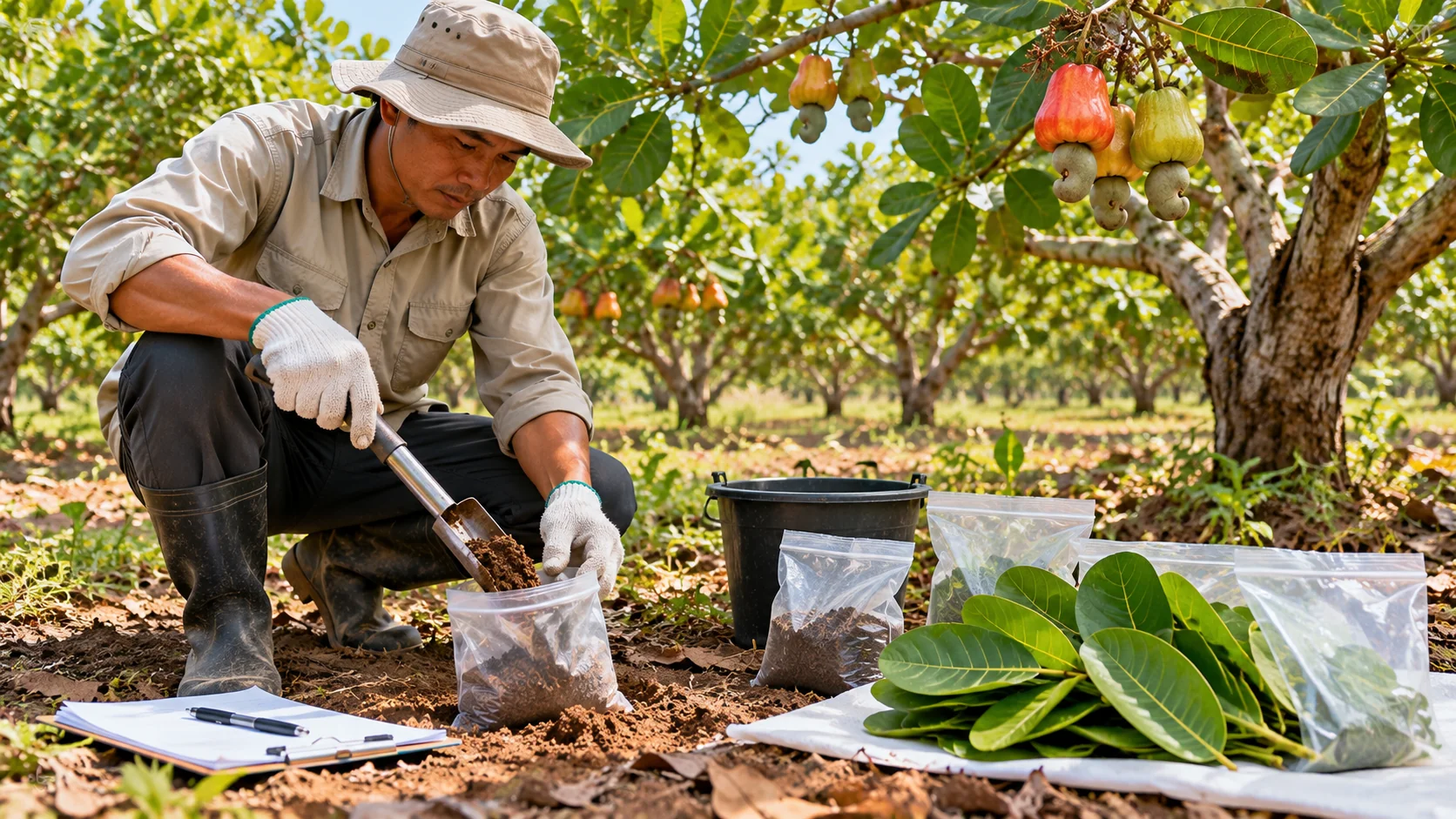
- Use clean tools. Prepare a clean auger or spade, plastic bucket, sample bags and labels. Avoid fertilizer contamination.
- Collect several subsamples. Walk across each reasonably uniform block; avoid unusual spots such as compost heaps and recent fertilizer deposits unless testing those spots specifically.
- Follow the laboratory’s depth protocol. Surface soil such as 0–30 cm is examined in some orchard guidance, but sampling depth and placement must suit the question and laboratory method. Keep depths separate.
- Mix only comparable subsamples. Prepare a composite for the same block and depth, then package the amount requested by the laboratory.
- Label and record. Include block, depth, sampling date, recent fertilizer use and relevant observations. Retain the laboratory report.
5. What leaf analysis adds
Leaf analysis measures nutrients in sampled plant tissue. Results depend on leaf maturity and position, variety or clone, season, flowering stage, moisture and crop load. Sampling must therefore follow a consistent protocol and an appropriate reference range.
A 2025 Brazilian study of four dwarf cashew clones over four years found that the fifth and sixth fully expanded leaves, counted down from the inflorescence at the start of flowering, were suitable for diagnosis in the material studied. This finding is not a validated universal protocol for Cambodian varieties.
6. Collecting leaf samples
Before sampling, ask the laboratory whether it accepts cashew leaves and which leaf position, stage, quantity, packaging and delivery method it requires. Select representative trees, keep blocks separate, avoid soil or foliar-spray contamination, and record variety, tree age, date, symptoms and recent treatments. When comparing healthy and affected trees, agree on a sampling design with the laboratory.
7. Interpret both tests together
| Soil result | Leaf result | What to investigate |
|---|---|---|
| Low availability | Low concentration | Possible nutrient supply limitation |
| Adequate availability | Low concentration | Root condition, moisture, pH, interactions and sampling |
| High availability | High concentration | Possible overapplication or imbalance |
| Adequate availability | Appropriate concentration | Continue monitoring and balanced management |
These are diagnostic starting points, not definitive diagnoses. Always review symptoms, orchard history and yield records.
8. Plan balanced fertilization
Record tree age, variety, soil type, rainfall, previous fertilizer applications and yields. Use laboratory interpretation to identify likely limiting factors. Consider organic amendments, mineral fertilizers, mulching, erosion prevention or soil correction only where justified. Select timing and placement carefully; avoid fertilizer against trunks and application before heavy runoff-producing rain. Record product, amount, cost, date and orchard response.
9. Mistakes to avoid
- Applying one fertilizer recipe to every orchard block.
- Diagnosing nutrient deficiency from leaf color alone.
- Mixing samples from different depths or contrasting soils.
- Collecting leaves without a consistent laboratory protocol.
- Applying lime without confirming the need.
- Assuming that more fertilizer always means more yield.
- Importing foreign fertilizer rates or leaf thresholds without Cambodian validation.
10. Simple monitoring record
| Field | Record |
|---|---|
| Orchard block | Block ID, variety and approximate tree age |
| Soil sampling | Date, depth, pH and laboratory nutrient results |
| Leaf sampling | Date, position, nutrient results and interpretation |
| Management | Fertilizer or amendment type, amount, timing and cost |
| Orchard response | Growth, symptoms, drainage, rainfall and yield |
| Next review | Follow-up action and review date |
Conclusion
Test first, interpret carefully, and fertilize according to demonstrated needs. For Cambodian orchards, combine internationally established principles with locally appropriate laboratory procedures and qualified agronomic advice. Specific fertilizer rates, soil amendments and nutrient sufficiency thresholds require local validation.
References
- Martins, T. da S., et al. (2025). Diagnostic leaves for evaluating dwarf cashew nutritional status. Revista Brasileira de Ciência do Solo. https://doi.org/10.36783/18069657rbcs20240080
- Taniguchi, C. A. K., et al. (2024). Avaliação do estado nutricional do cajueiro-anão. Embrapa. https://www.infoteca.cnptia.embrapa.br/infoteca/handle/doc/1166692
- ICAR — Directorate of Cashew Research. Crop Management. https://cashewresearch.in/home/research/crop-management/
- Washington State University Extension. Soil Sampling for Tree Fruit Orchards. https://treefruit.wsu.edu/soil-sampling-for-tree-fruit-orchards/