The quality of planting material is an important foundation for establishing a productive cashew orchard. Healthy seedlings with desirable genetic characteristics can support uniform orchard development, while poor-quality planting material may create long-term challenges for farmers.
Cashew trees can be propagated through seeds or vegetative methods. However, seedlings grown from seeds may differ from their parent trees in growth characteristics, nut quality and productivity. Vegetative propagation through softwood grafting offers a way to reproduce selected cashew varieties while retaining their desirable characteristics.
Producing quality grafted seedlings requires more than successful grafting. It also involves selecting suitable mother trees, preparing healthy rootstocks, maintaining nursery conditions and carefully assessing seedlings before field planting.
Quick Facts
- ✓Softwood grafting helps preserve desirable characteristics of selected cashew varieties.
- ✓Healthy mother trees and rootstocks are essential for quality planting material.
- ✓Cambium alignment and graft-union protection influence grafting success.
- ✓Nursery aftercare and hardening help prepare seedlings for field planting.
- ✓Research findings should be adapted to local Cambodian conditions.
🌳 1. Selecting a Suitable Mother Tree
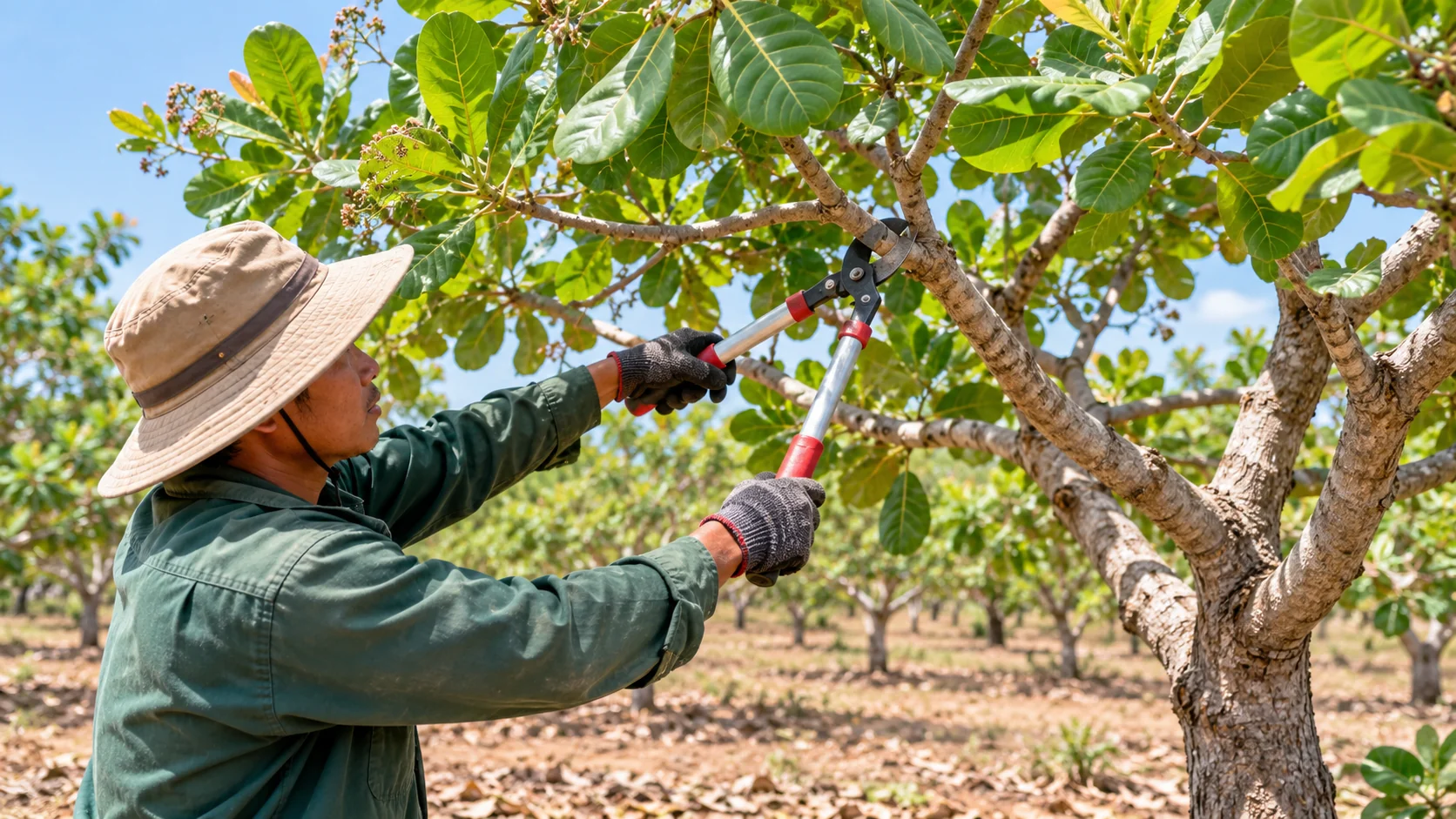
A mother tree is the source of the scion used in grafting. Its selection is important because the scion carries the genetic characteristics of the selected variety.
Nursery operators should consider trees with healthy growth, desirable nut characteristics and a reliable production history. They should also avoid collecting scions from trees showing visible disease symptoms.
A healthy mother tree does not guarantee that every grafted seedling will perform equally well in the field, because rootstock characteristics, nursery practices and environmental conditions also influence plant development.
🌿 2. Preparing Healthy Rootstocks
The rootstock is the lower part of the grafted plant, including its root system. It supports water and nutrient uptake and influences the establishment of the young tree.
Rootstocks should be raised from viable seeds in a well-managed nursery. Suitable growing media, drainage, watering and disease prevention help promote healthy root development.
Before grafting, nursery operators should select vigorous, appropriately developed rootstocks with healthy stems and leaves.
✂️ 3. Understanding Softwood Grafting
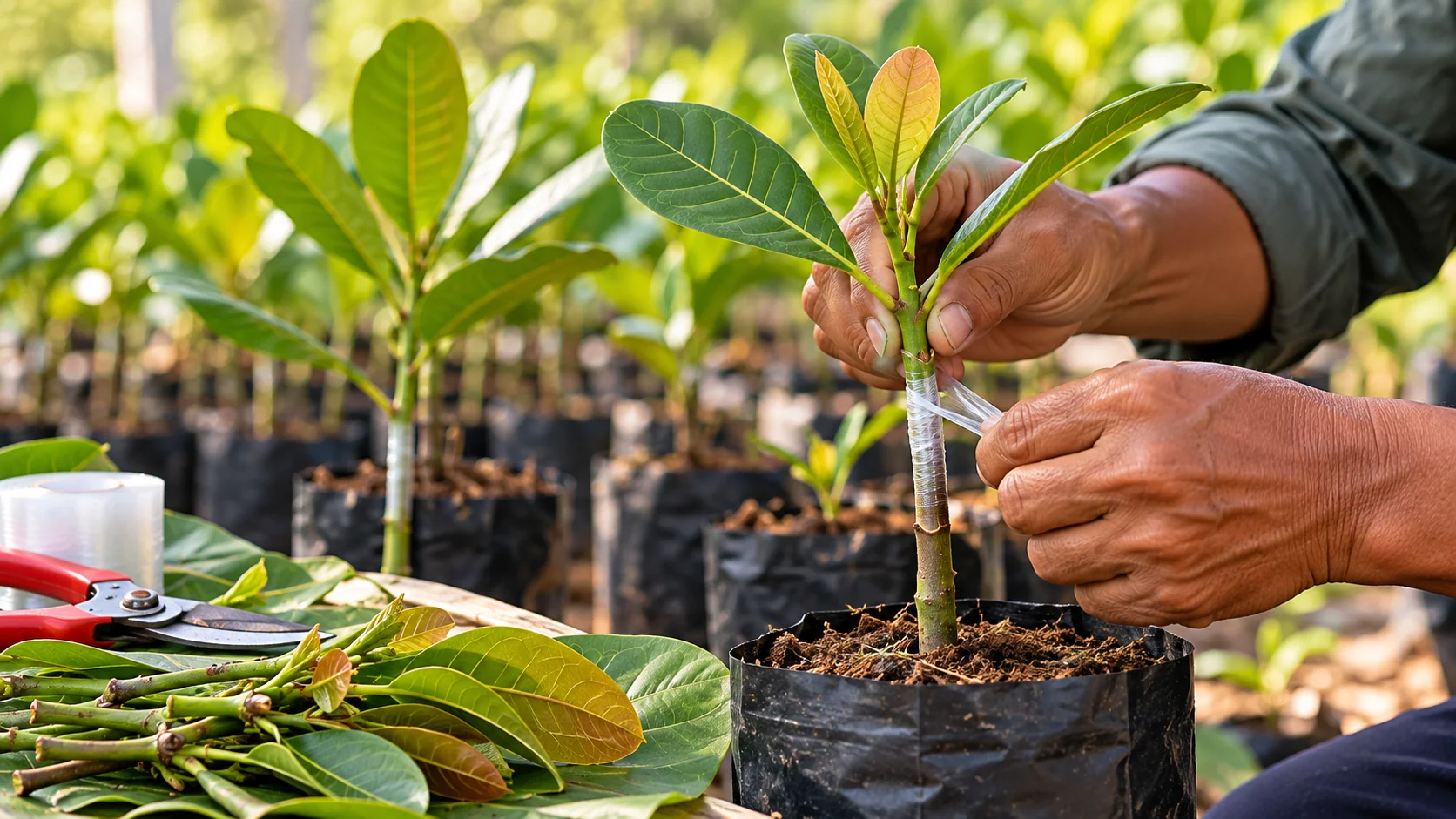
Softwood grafting joins a young scion from a selected mother tree to a compatible rootstock.
The process generally involves preparing the rootstock, selecting a suitable scion, making compatible cuts, aligning the cambial regions and securing the graft union with appropriate grafting material.
Successful grafting depends on plant condition, compatibility, technique and environmental management. Clean cutting tools are important for reducing contamination and tissue damage.
Grafting should be performed by trained nursery personnel or under suitable technical guidance.
💧 4. Nursery Management After Grafting
After grafting, seedlings require careful management while the graft union develops.
Nursery operators should maintain appropriate humidity, protect seedlings from excessive sunlight and avoid waterlogging. Water stress, excessive heat and poor sanitation can reduce graft survival.
New shoots emerging from the rootstock below the graft union should be removed because they can compete with the desired scion.
Gradual acclimatization, often called hardening, helps prepare successfully grafted seedlings for outdoor conditions before planting.
🔍 5. Assessing Grafted Seedling Quality
A grafted seedling should not be considered ready for planting simply because new leaves have appeared.
Quality assessment should consider the condition of the graft union, healthy shoot development, root-system condition and the absence of visible pest or disease problems.
Nursery operators should also check for root restriction or deformation in containers and avoid distributing seedlings with weak or damaged graft unions.
🧪 6. What Research Tells Us
Research on softwood grafting in Ghana has examined how rootstock age and leaf retention affect grafting success. The study reported favorable results for particular treatment combinations, including rootstocks around 60 days old with four retained leaves under its experimental conditions.
These findings demonstrate that nursery practices can influence grafting success. However, the results should not be interpreted as a universal recommendation for all cashew-growing regions.
Local climate, varieties, nursery environments and technical practices should be considered before adopting a specific grafting protocol.
🇰🇭 7. Practical Relevance for Cambodian Cashew Growers
For Cambodian cashew growers, access to healthy, correctly identified planting material can support better orchard establishment and long-term production planning.
Farmers purchasing grafted seedlings should ask nurseries about the source of the scion, the identity of the variety, nursery management practices and the condition of the graft union.
For nursery businesses, maintaining reliable records and consistent quality-control procedures can help improve traceability and customer confidence.
Further local research could help determine suitable grafting periods, rootstock characteristics and nursery management practices under Cambodian growing conditions.
🛡️ Key Practical Message
Quality grafted cashew seedlings begin with suitable mother trees and healthy rootstocks, but their successful production also depends on grafting skills, nursery management and careful inspection before planting.
Softwood grafting is a valuable propagation method, not a guarantee of high yield. Good orchard management and suitable local growing conditions remain essential.
⚠️ Important Research Note
Research findings from Ghana and India provide useful technical knowledge, but exact nursery practices should be validated under Cambodian conditions before being adopted as universal recommendations.
📚 Research Sources
- Indian Council of Agricultural Research (ICAR). (2025). Quality Cashew Production Techniques in Garo Hills, Meghalaya.
- Journal of Agricultural Science. (2020). Vegetative Propagation of Cashew by Softwood Grafting in Ghana.
- Kerala Agricultural University. (2011). Package of Practices Recommendations: Cashew.