Cashew apples can create value beyond the nut, but their short post-harvest life and astringent taste make juice processing challenging. This guide explains extraction, tannin reduction, nutritional quality, and food safety, distinguishing experimental research from validated production practices.
Quick Facts
- ✓Tannins contribute to the dry, puckering sensation of astringency.
- ✓Basic filtration may not remove dissolved tannins.
- ✓Clearer juice is not automatically safer or more nutritious.
- ✓Preservation and shelf life require product-specific validation.
- ✓Experimental treatments are not ready-made commercial recipes.
1. Understanding the Cashew Apple
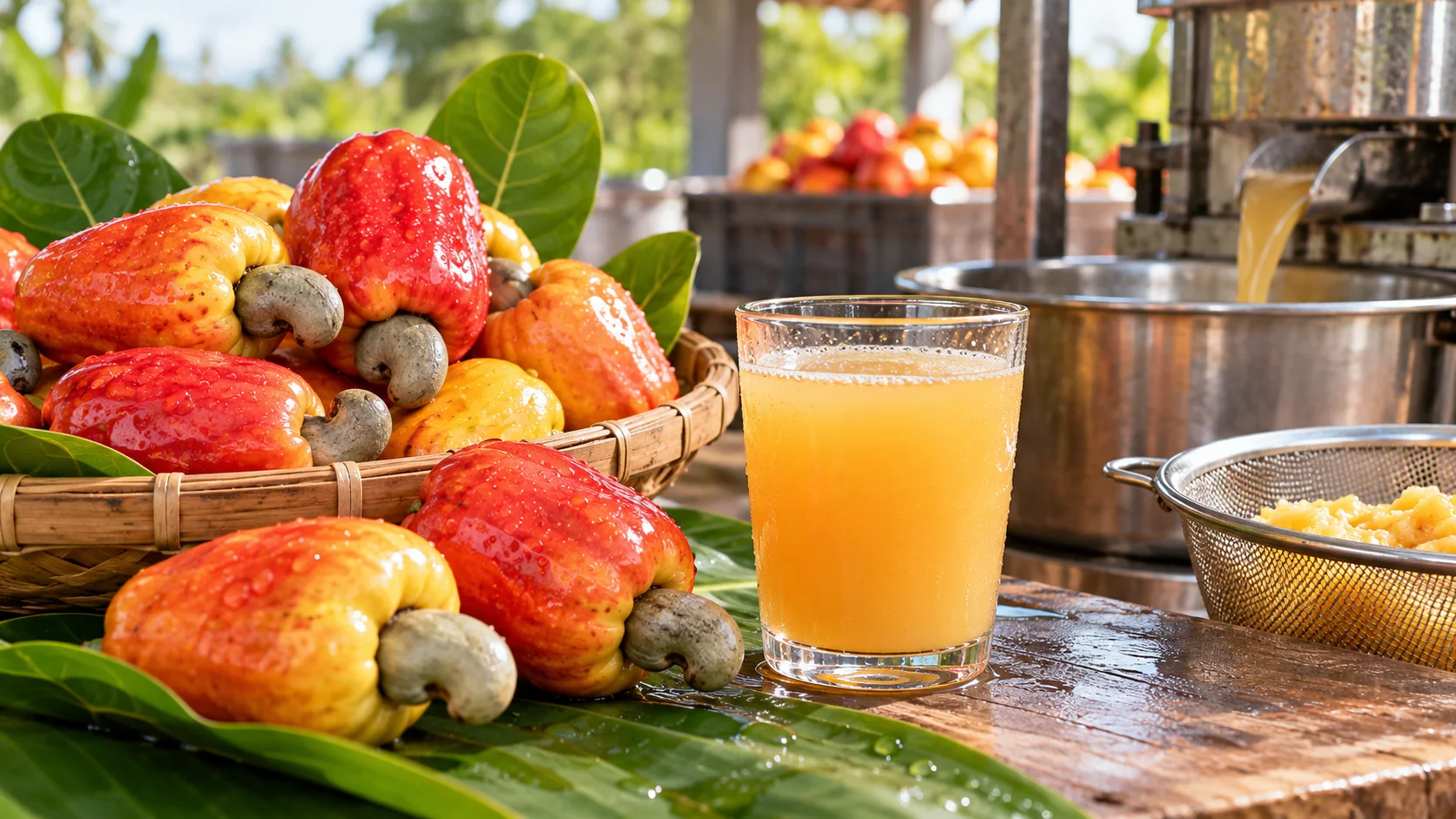
The cashew apple is the fleshy, juicy structure attached to the cashew nut. Botanically it is an accessory fruit, while the nut is the true fruit. Its high moisture content and delicate tissue make it far more perishable than dried raw cashew nuts. Fresh apples can be transformed into juice, syrups, preserves, and other value-added foods, but this guide addresses non-alcoholic juice only. Processing plans must account for rapid quality deterioration after harvest.
2. What Causes Astringency?
Cashew apple juice often produces a dry, puckering sensation known as astringency. This sensation is associated in part with tannins, a group of polyphenolic compounds that can interact with proteins in saliva. Astringency should not be confused with bitterness. The level of perceived astringency can vary with the fruit, extraction method, and subsequent treatment. A treatment that lowers measured tannins may improve acceptability, but sensory evaluation is still needed.
3. Raw Fruit Selection and Hygienic Handling
Select sound, ripe apples and reject fruit with visible mold, off-odors, fermentation, or serious damage. Separate the attached nut carefully; do not allow caustic cashew nut shell liquid to contaminate the edible apple. Wash using potable water and food-safe procedures, keep food-contact surfaces clean, and protect fruit from soil and pests. Minimize the time between harvesting and processing. Where processing is delayed, use an appropriately controlled cold chain rather than assuming fruit will remain safe at ambient temperature.
4. Juice Extraction and Clarification
Pressing and blending followed by suitable separation are two approaches to extracting juice. They can yield different amounts of suspended solids and soluble compounds. Clarification aims to reduce haze and suspended particles and, when a suitable fining treatment is used, may also reduce tannins. Simple sieving or filtration does not necessarily remove dissolved tannins. Record the fruit weight, juice yield, treatment, and observations for every trial so results can be compared reliably.
5. Research on Tannin Reduction
Aluko, Makule, and Kassim (2023) investigated gelatin clarification and differences between pressed and blended cashew apple juice. In one reported pressed-juice treatment, 0.2 g/L gelatin for two hours reduced measured tannins from 217.6 to 24.6 mg/100 mL, expressed as tannic acid equivalents. Singh and colleagues (2025) investigated plant-based clarifying materials, including taro and water chestnut powders; their experimental findings suggest these materials may reduce tannins under specified conditions. These are research observations, not validated commercial recipes. Processing conditions, ingredient approval, dietary and allergen considerations, residual solids, flavor, and microbiological safety all need local assessment before adoption.
6. Protecting Nutritional and Sensory Quality
Cashew apple juice can provide vitamin C and other compounds of nutritional interest. Clarification, oxygen exposure, heat, and storage may change their concentrations. A practical trial should measure or document pH, soluble solids (°Brix), tannins, vitamin C, color, aroma, taste, and juice yield, where suitable laboratory support is available. Compare treated juice with an untreated control. A clearer appearance alone does not demonstrate improved nutrition or food safety.
7. Food Safety, Packaging, and Shelf Life
Tannin reduction is not a microbial kill step. Apply good hygiene, use potable water and food-grade equipment, and control time and temperature. Any pasteurization or other preservation method must be selected and validated for the actual formulation, packaging, and distribution conditions. Packaging should be suitable for acidic beverages and the intended storage conditions. Shelf-life claims require appropriate microbiological and quality testing; without validation, do not market the juice as shelf-stable at room temperature.
8. Opportunities for Cambodian Processors
Cashew apples may offer additional value to Cambodian growers and small processors when the fruit can be collected and handled safely. Begin with a small, documented pilot rather than investing immediately in a commercial line. Compare extraction methods, assess consumer acceptance, estimate labor and equipment costs, and arrange food-safety testing with a qualified laboratory or technical institution. Commercial feasibility also depends on fruit availability, logistics, packaging, regulatory requirements, and access to buyers.
Conclusion
Cashew apple juice offers value-addition opportunities, provided processors balance astringency reduction with nutrient retention, sensory quality, and validated food safety.
References
- Aluko, A., Makule, E., & Kassim, N. (2023). Effect of clarification on physicochemical properties and nutrient retention of pressed and blended cashew apple juice. Food Science & Nutrition. https://doi.org/10.1002/fsn3.3222
- Singh, S., et al. (2025). Tannin Mitigation in Cashew Apple Juice using Taro and Water Chestnut Powders as Clarifying Agents. Current Research in Nutrition and Food Science Journal. https://doi.org/10.12944/CRNFSJ.13.Special-Issue-July.10