Cashew Moisture Standards
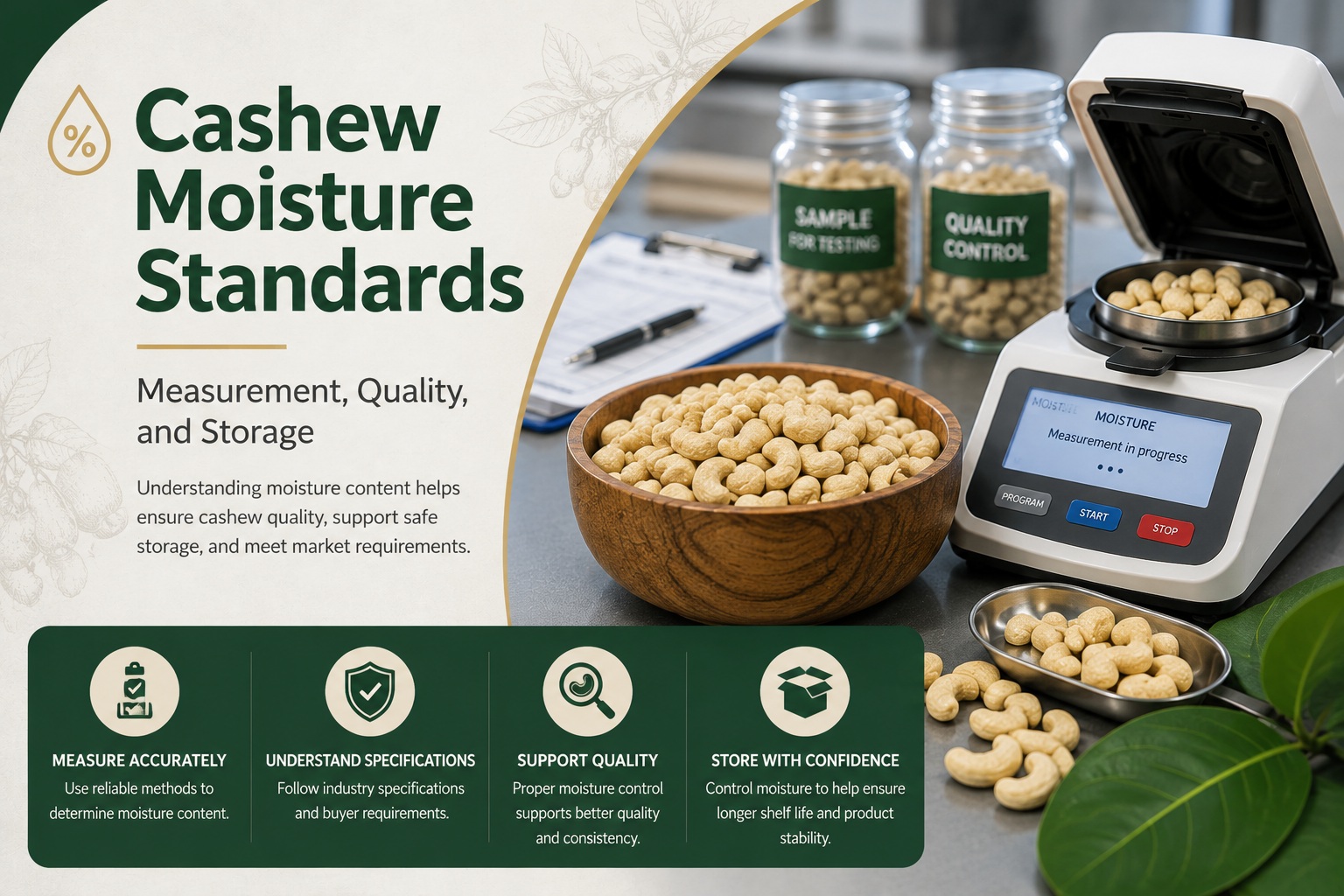
Moisture content is an important measurable property of cashew kernels. It matters during processing, influences physical quality and handling, affects storage stability, and is included in commercial quality specifications.
However, a moisture percentage has meaning only when its context is clear. The product stage, analytical method, reporting basis, applicable specification, and buyer or market requirement all affect how a result should be interpreted.
This guide explains the moisture specifications used for finished cashew kernels, the basic principle of moisture measurement, and how moisture connects processing, quality control, and storage.
Quick Facts
- ✓Moisture values must be interpreted according to the product stage being tested.
- ✓AFI specifications for cashew kernels state a moisture level of 3–5%.
- ✓UNECE DDP-17 (2023) sets a maximum moisture content of 5.0% for cashew kernels.
- ✓AFI and UNECE should be cited separately because their wording and scope are not identical.
- ✓Loss on drying determines moisture by measuring mass lost during a specified controlled drying procedure.
- ✓Moisture content and water activity are related concepts, but they are not the same measurement.
What Is Moisture Content in Cashew Kernels?
Moisture content describes the amount of water present in a sample, expressed relative to a defined mass basis. For finished cashew kernels, moisture is a useful quality-control parameter because kernels continue to interact with their processing and storage environment.
A percentage should never be interpreted in isolation. Before comparing two moisture results, it is important to know:
- What product was tested.
- At what processing stage it was tested.
- Which analytical method was used.
- Whether the result is expressed on a wet or dry basis.
- Which specification or buyer requirement applies.
Moisture content should also not be confused with water activity (aw). They describe different properties. This article focuses on moisture content because that is the parameter addressed by the cashew-kernel specifications discussed below.
Why Moisture Matters
Moisture connects several stages of the cashew value chain.
Processing
During conditioning, steaming, shelling, and drying, moisture changes as heat and water move through the nut and kernel. Moisture at these stages can affect processing behavior and whole-kernel recovery.
Physical Quality
The physical behavior of cashew kernels changes with moisture. This can influence handling, texture, and susceptibility to damage during processing and movement.
Storage Stability
After kernels have been dried and prepared as finished product, they still need protection from moisture exchange with the surrounding environment. Packaging, temperature, relative humidity, and storage practices all contribute to maintaining the intended condition.
Commercial Quality Control
Moisture is included in commercial cashew-kernel specifications. A measured result can therefore form part of product inspection, buyer acceptance, and quality documentation.
For the broader quality framework, see the Cashew Quality Standards guide in the Continue Learning section below.
Raw Cashew Nut vs Finished Kernel Moisture
A common mistake is to compare moisture values from different stages of production as though they describe the same condition.
The cashew moves through several distinct stages:
Raw cashew nut → conditioning or steaming → shelling → kernel drying → finished cashew kernel
Research on raw or pre-shelling cashew nuts may report moisture levels that are much higher than the commercial limits applied to finished kernels. Those figures answer different technical questions and should not be compared directly.
Always Identify the Product Stage
A moisture result for a raw cashew nut is not equivalent to a moisture result for a finished cashew kernel. Before using any numerical value, confirm what material was tested and at which stage of processing.
Cashew Moisture Specifications
Two important references for finished cashew kernels are the Association of Food Industries (AFI) specification and UNECE DDP-17.
AFI Specification
The AFI Specifications for Cashew Kernels, adopted in September 2023, state that the moisture level of cashews shall be 3–5%.
AFI also identifies recognized loss-on-drying approaches for determining moisture, including a moisture-balance method at 105°C, AACCI Method 44-15 (modified), or an equivalent method that correlates with the referenced AOAC method or equivalent vacuum-oven method.
UNECE DDP-17
UNECE DDP-17 — Cashew Kernels (2023) is a commercial and marketing quality standard for cashew kernels. It sets a maximum moisture content of 5.0%.
How the Specifications Differ
| Reference | Moisture Statement | Product / Scope | How to Interpret It |
|---|---|---|---|
| AFI | 3–5% | Cashew kernels / AFI industry specification | Cite as an AFI specification |
| UNECE DDP-17 (2023) | Maximum 5.0% | Cashew kernels / commercial and marketing quality | Cite as a UNECE requirement within its scope |
Both references converge around a 5% upper level, but their wording is not identical. AFI specifies a range, while UNECE expresses a maximum.
Do Not Turn Two Specifications Into One Universal Rule
It is inaccurate to state simply that “the global cashew moisture standard is 3-5%.” Identify the reference being used and check the specification, buyer requirement, contract, and destination-market requirements that apply to the product.
How Cashew Moisture Is Measured
A common analytical principle is loss on drying. At a high level, the workflow is:
- Obtain a representative sample.
- Record the initial sample mass.
- Dry the sample under the conditions required by the analytical method.
- Record the final mass.
- Determine moisture from the measured loss in mass according to the specified calculation.
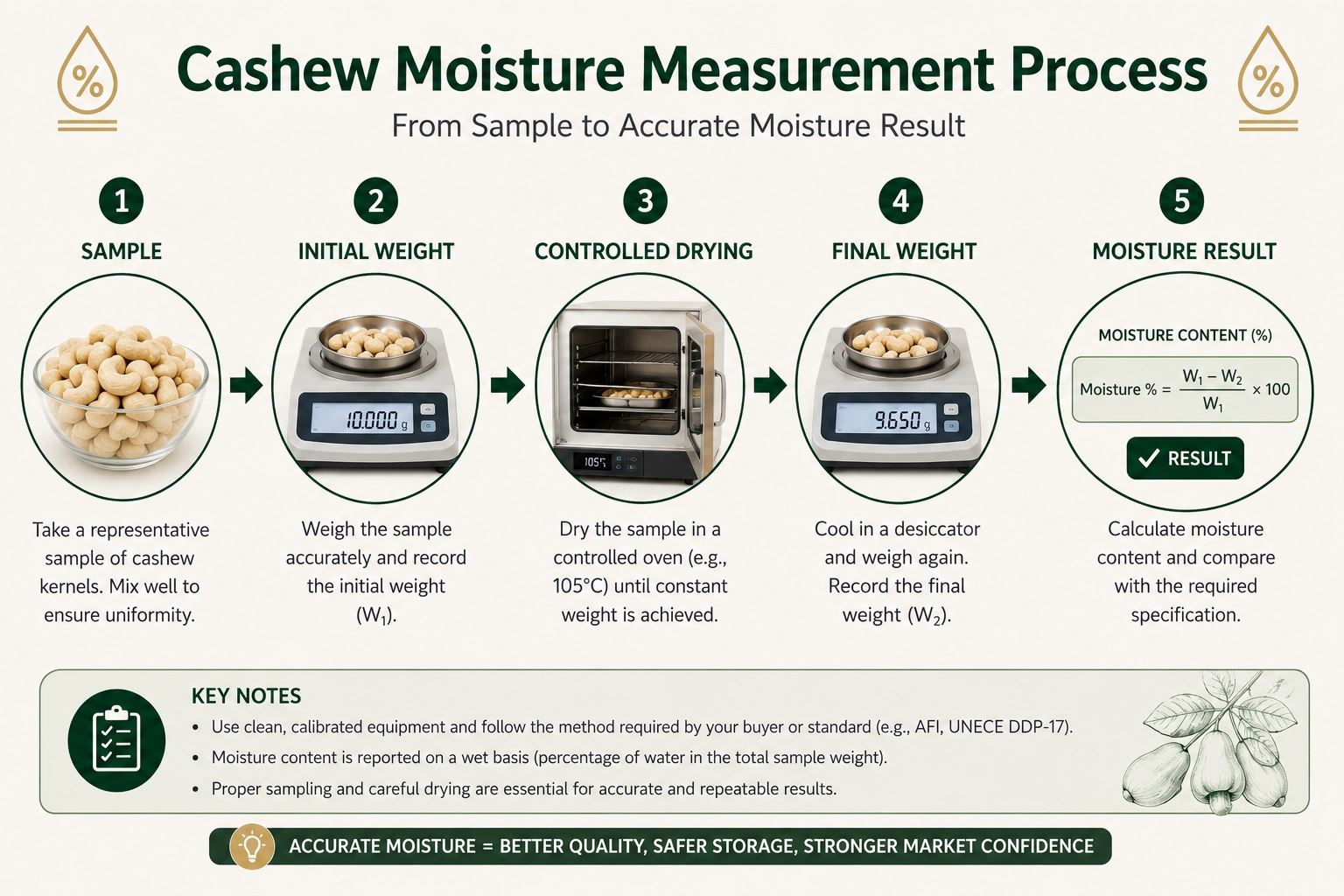
Conceptual loss-on-drying workflow. Commercial testing should follow the analytical method required by the applicable specification, buyer, laboratory procedure, or contract.
Measurement Method Matters
A moisture result is only as useful as the sampling and test method behind it. Commercial acceptance testing should follow the method required by the applicable specification, buyer, laboratory, or contract. A convenient field or handheld reading should not automatically be treated as equivalent to a specified analytical method.
Wet Basis vs Dry Basis
Moisture percentages can be expressed using different calculation bases. This matters when comparing specifications, scientific research, and process data.
Wet Basis
On a wet basis, the water is expressed as a proportion of the total mass of the wet sample.
Dry Basis
On a dry basis, the water is expressed relative to the mass of the dry solids.
The same material can therefore produce different numerical percentages depending on the basis used. Always check the reporting basis before comparing results from different sources.
Check the Basis Before Comparing Numbers
Do not assume that two moisture percentages are directly comparable simply because both are written with a percent sign. Confirm the product stage, analytical method, and reporting basis first.
What Happens When Moisture Is Not Properly Controlled?
Moisture outside the condition intended for a particular processing stage or finished-product specification can create quality-control problems.
| Area | Why Moisture Control Matters |
|---|---|
| Processing | Moisture can influence shelling behavior, drying performance, physical handling, and whole-kernel recovery |
| Finished Quality | Moisture is a measurable commercial quality parameter and can influence texture and physical condition |
| Storage | Moisture exchange can change product condition and reduce storage stability |
| Food Safety | Poor moisture control combined with unsuitable storage conditions can contribute to mold and hygiene concerns |
| Commercial Acceptance | A result outside the applicable specification or buyer requirement may affect product acceptance |
These effects should not be reduced to unsupported universal thresholds. For example, it would be misleading to claim that every kernel above one number will develop mold or that every kernel below another number will break. Actual outcomes depend on product condition, process, packaging, environment, time, and other controls.
Moisture During Processing
Moisture begins as a processing variable before it becomes a finished-product specification.
Raw cashew nuts may be conditioned or steam-treated before shelling. During these operations, moisture and heat affect the physical behavior of the shell and kernel. Drying later reduces kernel moisture as the product moves toward peeling, grading, packing, and finished-product quality control.
Research on pre-shelling cashew nuts has shown that moisture interacts with factors such as steam exposure and nut size and can affect whole-kernel out-turn. This is one reason raw-nut moisture data should not be substituted for finished-kernel specifications.
For the complete production sequence, see The Complete Guide to Cashew Processing in Continue Learning.
Moisture During Storage
Achieving an appropriate finished-kernel moisture condition is only part of moisture control. That condition must also be protected after processing.
Cashew kernels can gain or lose moisture depending on their environment. Relative humidity, temperature, package integrity, storage duration, and handling all influence the protection of the finished product.
AFI commercial specifications also emphasize clean, dry, leakproof, airtight or hermetically sealed packaging for shipment and storage. This illustrates the connection between moisture specification and the packaging/storage system.
For practical warehouse and storage guidance, continue to the Cashew Storage Guide rather than treating this moisture article as a complete storage procedure.
How to Interpret a Moisture Result
A moisture percentage should be interpreted through four questions.
1. What Product Stage Was Tested?
Was the sample a raw cashew nut, an in-process kernel, or a finished cashew kernel?
2. Which Method Was Used?
Was the result obtained using the analytical method required by the specification or buyer?
3. What Basis Is Being Reported?
Is the percentage on a wet basis or dry basis?
4. What Requirement Applies?
Is the number being compared with:
- an AFI specification;
- UNECE DDP-17;
- an internal process target;
- a buyer or contract requirement; or
- a scientific research condition?
Context Gives the Number Meaning
A moisture result becomes useful only when the product stage, method, basis, and specification context are known. Recording these details improves traceability and reduces incorrect comparisons.
Common Moisture-Control Mistakes
Common interpretation and control mistakes include:
- Treating one industry’s specification as a universal global requirement.
- Comparing raw cashew nut moisture directly with finished-kernel specifications.
- Comparing wet-basis and dry-basis values without checking how they were calculated.
- Using an unvalidated instrument reading as a substitute for a required analytical method.
- Allowing dried kernels to reabsorb moisture because of unsuitable storage or damaged packaging.
- Reporting a moisture percentage without identifying the test method or product stage.
- Assuming moisture content and water activity are the same measurement.
- Ignoring buyer, contract, or destination-market requirements.
Key Takeaways
- ✓Moisture must always be interpreted in relation to the product stage, method, basis, and applicable specification.
- ✓AFI specifies 3–5% moisture for cashew kernels.
- ✓UNECE DDP-17 (2023) sets a maximum moisture content of 5.0% for cashew kernels.
- ✓AFI and UNECE should be cited separately rather than combined into one universal standard.
- ✓Loss on drying is a recognized analytical principle for determining moisture.
- ✓Raw-nut moisture and finished-kernel moisture describe different stages and should not be compared directly.
- ✓Storage and packaging help protect the moisture condition achieved during processing.
Frequently Asked Questions
What is the recommended moisture content for cashew kernels?
There is no single wording that should be presented as a universal global requirement. AFI specifications state 3–5% moisture for cashew kernels, while UNECE DDP-17 (2023) sets a maximum moisture content of 5.0%. The applicable specification, buyer requirement, contract, and market should be checked.
Is 3–5% a global cashew moisture standard?
No. The 3–5% range is specifically stated in the AFI Specifications for Cashew Kernels. UNECE DDP-17 uses different wording and sets a maximum of 5.0%. Each reference should be identified according to its own scope.
What does UNECE DDP-17 require for cashew moisture?
The 2023 UNECE DDP-17 standard for cashew kernels sets a maximum moisture content of 5.0% within its commercial and marketing quality scope.
How is cashew moisture measured?
A recognized approach is loss on drying: a representative sample is weighed, dried under the conditions specified by the analytical method, weighed again, and the mass loss is used to determine moisture. Commercial testing should follow the method required by the applicable specification or buyer.
What is the difference between wet-basis and dry-basis moisture?
Wet-basis moisture expresses water relative to the total wet sample mass, while dry-basis moisture expresses water relative to the dry solids. The basis should be checked before numerical results are compared.
Can a handheld moisture meter replace a laboratory method?
Not automatically. A field or handheld instrument may be useful for process monitoring if it is suitable and validated, but commercial acceptance should use the analytical method required by the relevant specification, buyer, laboratory procedure, or contract.
Why is moisture important during cashew storage?
Finished kernels can exchange moisture with their environment. Packaging integrity, relative humidity, temperature, handling, and storage time therefore matter when protecting the product condition achieved during processing.
Is moisture content the same as water activity?
No. Moisture content and water activity describe different properties. This guide focuses on moisture content because it is the parameter addressed by the cashew-kernel specifications discussed here.