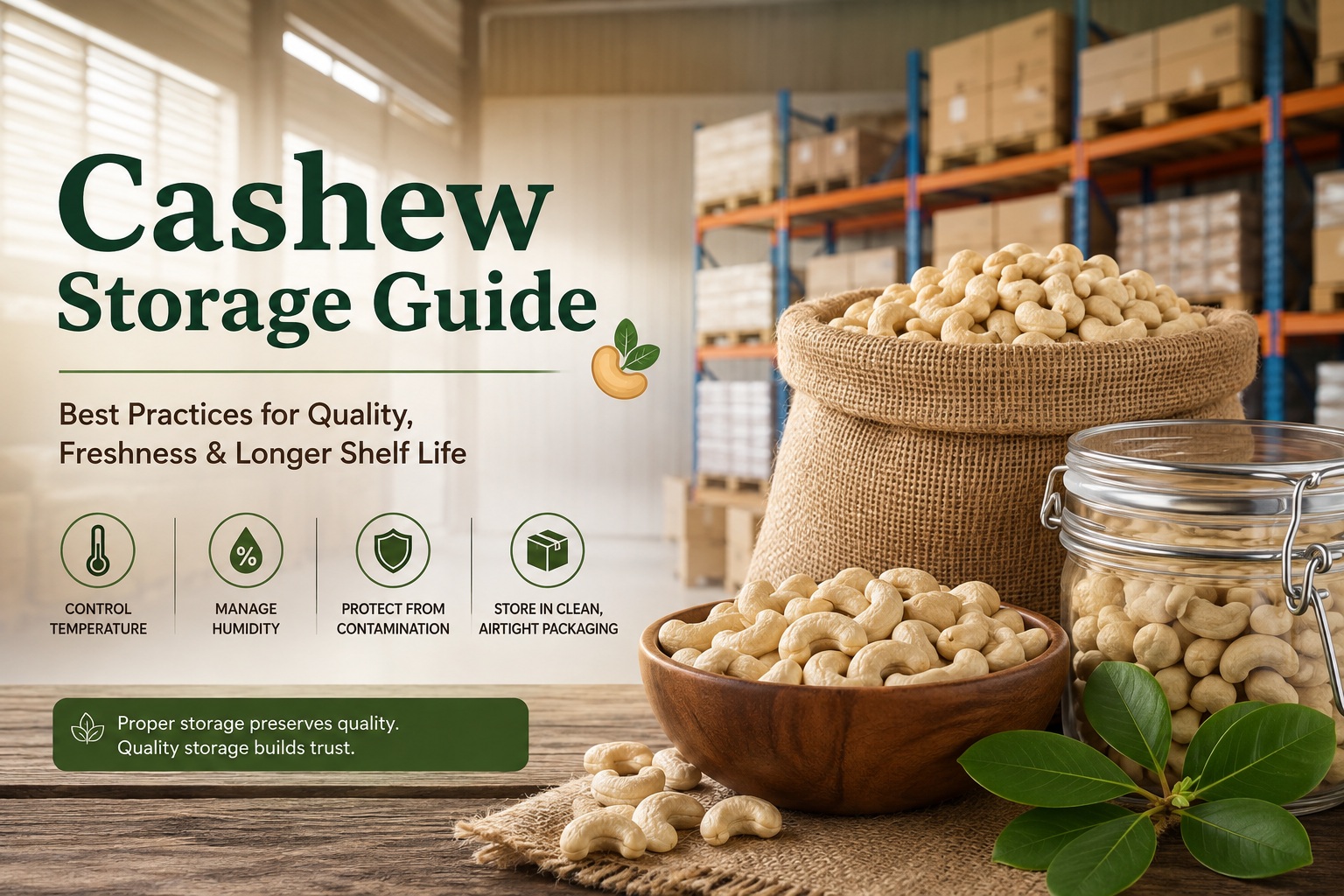
Cashew Storage Guide
Proper storage is essential after cashew kernels have been processed, graded, and inspected. Even high-quality kernels can deteriorate when they are exposed to unsuitable temperature, excess humidity, moisture, air, pests, or poor handling conditions.
A well-managed storage system helps preserve flavor, texture, appearance, food safety, and commercial value while reducing avoidable product losses.
For processors, exporters, retailers, and consumers, understanding the main storage factors makes it easier to protect cashew quality throughout the supply chain.
Quick Facts
- ✓Temperature, humidity, moisture, packaging, and storage time all influence cashew quality.
- ✓Cashew kernels should be protected from moisture, contamination, pests, and strong odors.
- ✓Airtight or hermetic commercial packaging helps protect kernels during shipment and storage.
- ✓AFI specifications set commercial cashew kernel moisture at 3–5%.
- ✓Storage-life estimates depend on product condition, packaging, and storage environment.
Why Proper Cashew Storage Matters
Storage is not simply the period between processing and sale. It is an active quality-control stage that helps protect the condition achieved during drying, peeling, grading, and final inspection.
Poor storage can contribute to:
- Moisture uptake.
- Loss of crisp texture.
- Mold or visible deterioration.
- Insect or pest activity.
- Off-aromas and off-flavors.
- Rancidity caused by deterioration of kernel oils.
- Reduced shelf life and commercial value.
Storage Is Part of Quality Control
Good processing cannot compensate for poor storage. Once kernels are packed, their environment must continue to protect them from moisture, heat, contamination, and physical damage.
What Affects Cashew Quality During Storage?
Several factors interact during storage. Managing only one factor is rarely enough to protect product quality over time.
| Storage Factor | Why It Matters | Poor Control Can Lead To |
|---|---|---|
| Temperature | Influences the rate of quality deterioration | Faster loss of freshness and shorter storage life |
| Relative Humidity | Affects moisture movement between kernels and the surrounding air | Moisture uptake, texture changes, or mold risk |
| Kernel Moisture | Influences stability, texture, and storage performance | Mold risk when excessive or brittleness when unsuitable |
| Air and Oxygen | Can contribute to oxidation of kernel oils | Rancid flavors and off-aromas |
| Packaging | Provides a barrier against moisture, contamination, and physical damage | Loss of product protection |
| Time | Quality gradually changes during storage | Greater deterioration when storage conditions are poor |
Temperature and Relative Humidity
Cool, controlled storage helps slow quality deterioration. Temperature and relative humidity should be considered together because warmer conditions can make moisture management more difficult.
The Association of Food Industries (AFI) notes that industry experience supports proper-condition storage of cashews and cites general tree-nut guidance of approximately 0–10°C (32–50°F) with 55–70% relative humidity.
These figures should be understood as storage guidance rather than a universal requirement for every cashew product, package, warehouse, or destination market.
Control the Storage Environment
For commercial storage, temperature and humidity should be monitored according to product specifications, packaging system, buyer requirements, and applicable food-safety procedures.
Moisture Control
Moisture is one of the most important factors affecting cashew storage stability. Kernels can interact with moisture in the surrounding environment, especially when packaging does not provide an effective barrier.
AFI specifications for cashew kernels set moisture at 3–5%, measured using recognized loss-on-drying methods. This is a commercial specification and should not be treated as a universal rule for every product or market.
| Moisture Condition | Possible Effect |
|---|---|
| Excessive Moisture | Greater risk of mold, quality deterioration, and reduced storage stability |
| Controlled Moisture | Supports stable texture and product quality during storage |
| Unsuitable Low Moisture | Kernels may become more brittle and susceptible to breakage |
Specification vs. General Advice
The 3–5% moisture range is an AFI specification for cashew kernels. Final requirements should always be checked against buyer specifications, contracts, processing controls, and the regulations of the destination market.
Packaging and Protection
Packaging is part of the storage system. It helps separate finished kernels from the external environment and protects them during handling, warehousing, and transportation.
AFI commercial specifications call for cashews to be packed in new, clean, dry, leakproof containers with an airtight or hermetic seal and sufficient strength to protect product integrity during normal shipment and storage.
Effective packaging helps protect kernels from:
- Moisture exchange.
- Dust and foreign material.
- Insects and other pests.
- Physical damage.
- Unwanted exposure to air.
- Odor transfer from nearby materials.
Packaging Protects Stored Quality
Storage conditions and packaging work together. A good warehouse cannot fully protect kernels if the package is damaged, poorly sealed, wet, or contaminated.
Air, Heat, Light, and Rancidity
Cashews contain natural oils that contribute to their flavor and nutritional value. Over time, deterioration of these oils can produce rancid flavors or aromas.
Higher storage temperatures and unnecessary exposure to air can accelerate quality loss. Commercial storage should therefore minimize avoidable heat exposure, protect packaging integrity, and keep finished product away from direct sunlight where practical.
Rancidity should not be confused with visible mold. A kernel may develop an unacceptable off-flavor or aroma even when no visible fungal growth is present.
Storage Hygiene and Food Safety
Storage areas are part of the food-safety system. Finished kernels should remain protected from contamination after processing is complete.
Good storage hygiene includes:
- Keeping storage areas clean and dry.
- Preventing pest access and monitoring for infestation.
- Protecting products from dust, chemicals, and foreign materials.
- Keeping packages off the floor using suitable pallets or racks.
- Separating food products from strong-smelling or contaminating materials.
- Checking packages for damage, leaks, moisture, or visible mold.
- Maintaining traceability through lot and date identification.
Visible Mold or Infestation Requires Attention
Products showing visible mold, pest activity, abnormal odors, or damaged packaging should not simply be mixed back into normal stock. They require evaluation under the facility’s food-safety and quality-control procedures.
Practical Storage Practices
A consistent storage routine helps identify problems before they affect a larger quantity of product.
Before Storage
- Confirm that finished kernels meet the required moisture and quality specification.
- Inspect packaging for cleanliness, dryness, seal integrity, and physical damage.
- Verify lot identification and traceability information.
- Make sure the storage area is clean and ready to receive finished product.
During Storage
- Maintain the required temperature and humidity conditions.
- Keep products protected from direct heat and sunlight.
- Store packages on suitable pallets or racks rather than directly on the floor.
- Maintain pest-control and sanitation programs.
- Avoid storing cashews near chemicals or strong-smelling products.
- Inspect stock periodically for package damage, moisture, mold, or infestation.
Stock Management
A documented stock-rotation system helps prevent products from remaining in storage longer than intended. Commercial operators should also monitor shelf-life status and follow buyer or product specifications when releasing finished goods.
How to Recognize Quality Deterioration
Storage inspection should consider more than appearance alone.
| Warning Sign | What It May Indicate |
|---|---|
| Rancid or unusual aroma | Oil deterioration, oxidation, contamination, or odor absorption |
| Off-flavor | Quality deterioration or contamination |
| Visible mold | Moisture-related fungal growth or unsuitable storage conditions |
| Insect activity | Infestation in the product, package, or storage environment |
| Soft or abnormal texture | Possible moisture uptake or quality change |
| Damaged or leaking package | Reduced protection from moisture, air, pests, or contamination |
Storage Life and Shelf Life
Storage life is not determined by time alone. Product condition at packing, moisture, temperature, relative humidity, packaging, oxygen exposure, and handling all influence how well kernels retain quality.
AFI states that empirical industry knowledge suggests it is reasonable to expect approximately 24 months of storage life when cashews are stored under proper conditions.
This figure should not be presented as a guaranteed expiry period. A specific commercial shelf life should be established and managed using the product specification, packaging system, processing controls, storage conditions, and market requirements.
Storage Life Is Not a Guarantee
A 24-month storage-life reference describes an industry expectation under proper conditions. It does not replace a product-specific shelf-life program or the date and storage instructions established by the manufacturer.
Common Storage Mistakes
Common problems that can reduce storage performance include:
- Storing cashews in warm or humid areas without adequate control.
- Using damaged, wet, dirty, or poorly sealed packaging.
- Placing finished product directly on the floor.
- Ignoring changes in temperature or humidity.
- Mixing new stock with older stock without rotation controls.
- Storing kernels near chemicals or strong odors.
- Failing to inspect for pests, mold, package damage, or off-aromas.
- Treating a general storage-life estimate as a guaranteed expiry period.
Key Takeaways
- ✓Proper storage protects the quality achieved during processing and grading.
- ✓Temperature, humidity, kernel moisture, packaging, air exposure, and time all matter.
- ✓AFI commercial specifications set cashew kernel moisture at 3–5%.
- ✓Clean, dry, airtight or hermetic packaging helps protect kernels during storage and shipment.
- ✓Visible mold, infestation, off-aromas, and damaged packaging are important warning signs.
- ✓Shelf life depends on actual product and storage conditions and should not be treated as a universal guarantee.
Frequently Asked Questions
What are the most important conditions for storing cashew kernels?
The main factors are temperature, relative humidity, kernel moisture, packaging integrity, cleanliness, pest control, and storage time. These factors work together to protect quality.
What moisture level is specified for commercial cashew kernels?
AFI specifications set cashew kernel moisture at 3–5%. This should be understood as a commercial specification rather than a universal requirement for every market or product.
Why is airtight packaging important for cashews?
Airtight or hermetic packaging helps protect kernels from moisture exchange, contamination, pests, and unnecessary exposure to the external environment during shipment and storage.
How long can cashews be stored?
AFI notes that industry experience supports an expectation of about 24 months under proper conditions, but actual shelf life depends on the product, packaging, storage environment, and manufacturer specifications.
How can you tell if stored cashews have deteriorated?
Warning signs include rancid or unusual odors, off-flavors, visible mold, insect activity, abnormal texture, and damaged or leaking packaging.
Does proper storage replace food-safety controls?
No. Storage is one part of the food-safety and quality system. Hygienic processing, suitable packaging, pest control, traceability, inspection, and applicable regulatory requirements are still necessary.