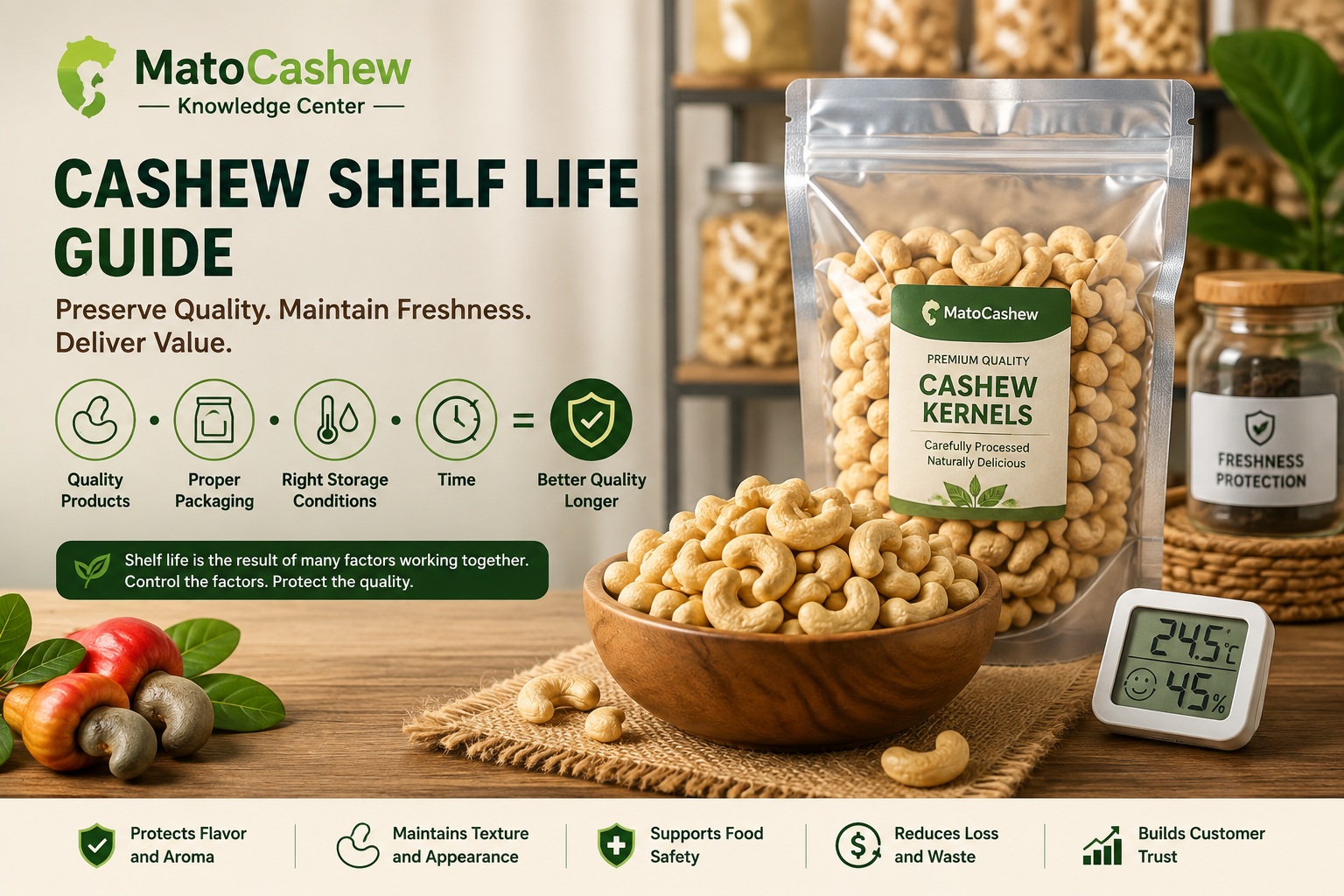
Cashew Shelf Life Guide
Cashew shelf life is not one fixed number that applies to every product. It depends on the condition of the cashews when storage begins, their moisture condition, the packaging system, the storage environment, the product form, and how quality changes over time.
For processors, buyers, exporters, retailers, and other supply-chain participants, the useful question is therefore not simply “How many months do cashews last?” It is “How long does this defined cashew product remain acceptable in this package under these defined conditions and acceptance criteria?”
Understanding that distinction helps prevent unsupported shelf-life claims and connects shelf-life decisions with quality control, packaging, storage, and product-specific validation.
Quick Facts
- ✓Cashew shelf life is a system outcome rather than one universal number.
- ✓Initial product condition, moisture, packaging, storage environment, and time work together to influence quality.
- ✓Raw cashew nuts, processed kernels, roasted kernels, and flavoured products should not automatically be assigned the same shelf life.
- ✓Oxidation can contribute to rancid aroma and flavour as cashew quality deteriorates.
- ✓A study observation period is not automatically the validated shelf life of every cashew product.
- ✓Real-time and accelerated shelf-life studies serve different purposes and should not be treated as interchangeable.
- ✓Quality shelf life is not the same as food-safety validation or automatic legal date marking.
What Is Cashew Shelf Life?
Shelf life describes the period during which a defined product remains acceptable when it is kept under defined conditions and assessed against defined criteria.
For cashews, those criteria may involve several dimensions of quality rather than one measurement alone. Depending on the product and purpose, evaluation may consider chemical change, moisture-related change, texture, colour, aroma, flavour, microbiological condition, package integrity, or pest condition.
This means shelf life should always be interpreted in context:
Product + Package + Storage Conditions + Acceptance Criteria + Time
The result is specific to the system being evaluated.
Shelf Life Is Not One Universal Number
It is tempting to describe cashew shelf life with a simple number of months. That can be misleading when the underlying product and conditions are not defined.
Two cashew products may behave differently because they differ in:
- Processing history.
- Initial quality.
- Moisture condition.
- Product form.
- Packaging material or atmosphere.
- Seal integrity.
- Temperature and humidity exposure.
- Light and handling.
- Distribution conditions.
- Acceptance criteria.
Avoid Universal Shelf-Life Claims
A shelf-life duration from one study, supplier, package, or storage condition should not automatically be applied to every cashew product. A study that observes cashews for a particular period also does not prove that the same period is a validated shelf life for all cashews.
What Determines Cashew Shelf Life?
Shelf life can be understood as the outcome of several interacting factors.
| Factor | Why It Matters | Control Context |
|---|---|---|
| Initial Product Condition | Sets the starting quality before the shelf-life period is evaluated | Processing, grading, inspection, product specification |
| Moisture Condition | Influences physical stability and interaction with the storage environment | Drying, measurement, packaging, humidity control |
| Oxygen Exposure | Can contribute to oxidative deterioration of kernel oils | Package barrier, seal integrity, package atmosphere |
| Packaging | Helps control environmental exposure and physical protection | Material performance, sealing, package integrity |
| Temperature and Humidity | Influence the environment in which quality changes occur | Storage and distribution conditions |
| Time | Allows chemical, physical, sensory, and other changes to accumulate | Shelf-life study and validated product period |
Managing one factor alone does not establish shelf life. The factors must be considered as a system.
Initial Product Condition
Shelf-life performance begins with the condition of the product at the start of storage.
Important starting characteristics may include:
- Product form and processing history.
- Moisture condition.
- Kernel integrity and physical quality.
- Existing defects or deterioration.
- Cleanliness and hygienic condition.
- Condition at the time of packing.
A package cannot reverse deterioration that has already occurred. Shelf-life validation should therefore begin with a clearly defined product and starting specification.
For the broader commercial-quality context, see Cashew Quality Standards.
Moisture and Water Activity
Moisture is an important part of cashew stability, but moisture content and water activity are not interchangeable concepts.
Finished-kernel moisture is influenced by processing and must then be protected against unwanted change during packaging and storage. Environmental humidity and package performance can affect whether the product gains or loses moisture over time.
The full technical discussion of moisture specifications, measurement, and interpretation belongs in Cashew Moisture Standards.
For shelf-life purposes, the key principle is simpler:
The moisture condition at packing and the ability to protect that condition during storage are part of the shelf-life system.
Oxygen and Oxidation
Cashew kernels contain oils that can undergo oxidative deterioration.
As oxidation develops, chemical changes can eventually contribute to undesirable sensory effects such as rancid or unusual aromas and flavours. Temperature, oxygen exposure, time, product condition, and packaging can all influence the environment in which these changes occur.
Oxidation should not be reduced to one universal threshold or one test result. A shelf-life program may use chemical measurements together with sensory, physical, and other acceptance criteria appropriate to the product.
Packaging and Seal Integrity
Packaging helps separate cashew kernels from the external environment. Depending on the system, it may help manage moisture exchange, oxygen exposure, contamination, physical damage, and package atmosphere.
However:
Packaging technology alone does not determine shelf life.
A high-barrier package with a damaged seal may fail to provide its intended protection. Similarly, vacuum packaging or another atmosphere-control method should not be treated as a guarantee of a specific number of months.
For package systems, hermetic protection, vacuum, gas flushing, barrier properties, and traceability, see the Cashew Packaging Guide.
Temperature and Humidity
Temperature and humidity are important parts of the storage environment.
Temperature can influence the rate at which quality changes occur, while humidity can interact with product moisture and package performance. The actual effect depends on the complete product/package/storage system.
This is why a generic table claiming that cashews last a fixed number of months at room temperature, in a refrigerator, or in a freezer can be misleading without product-specific evidence.
Temperature Matters, but Duration Still Requires Validation
Lower or controlled temperatures may change deterioration behaviour, but temperature alone does not establish a commercial shelf life. Exact refrigerated, frozen, or ambient durations should be supported by evidence for the defined product and package.
For warehouse conditions, humidity, stock rotation, pests, hygiene, and handling, see the Cashew Storage Guide.
Light, Handling, and Storage Environment
Shelf-life performance can also be influenced by conditions beyond temperature and humidity.
Relevant considerations may include:
- Light exposure.
- Package puncture or damage.
- Compression and rough handling.
- Pest activity.
- Exposure to unsuitable odours or contaminants.
- Poor stock rotation.
- Changes in distribution or storage conditions.
These factors reinforce an important principle: shelf life is evaluated for the conditions the product is expected to experience, not in isolation from the supply chain.
Product Form Matters
“Cashew” can refer to products at very different stages of processing. Evidence from one form should not automatically be transferred to another.
| Product Form | Shelf-Life Context | Interpretation |
|---|---|---|
| Raw Cashew Nuts (RCN) | In-shell agricultural storage before kernel processing | RCN storage evidence should remain identified as RCN evidence |
| Processed / Unroasted Kernels | Finished-kernel quality, packaging, storage, and commercial handling | Requires evidence relevant to the finished kernel system |
| Roasted Kernels | Heat-processed product with a different processing history | Do not automatically apply unroasted-kernel results |
| Flavoured / Formulated Products | Additional ingredients and processing can change the product system | Requires validation for the actual formulation and package |
Keep Product Evidence in Scope
A shelf-life result for raw cashew nuts, roasted kernels, cashew oil, or another cashew product can help explain a mechanism or research context, but it should not be rewritten as the validated shelf life of a different cashew product.
How Cashew Quality Changes Over Time
Shelf-life evaluation may involve several dimensions.
| Dimension | Examples of What May Be Evaluated | Role in Shelf-Life Assessment |
|---|---|---|
| Chemical | Oxidative change and related analytical indicators | Helps track chemical deterioration |
| Physical | Moisture, water activity, texture, hardness, colour | Helps identify physical changes affecting product quality |
| Sensory | Aroma, flavour, texture perception, acceptability | Helps determine whether product quality remains acceptable |
| Microbiological | Microbial or fungal condition where relevant | Supports evaluation appropriate to the product and safety/quality program |
| Package / Pest | Seal integrity, package damage, infestation | Identifies failures in protection or storage condition |
The correct combination of tests depends on the defined product, purpose, specification, and acceptance criteria. No single row in this table should be treated as a universal shelf-life test.
Recognizing Quality Deterioration
Possible warning signs of deterioration may include:
- Rancid, stale, or otherwise unusual aroma.
- Unacceptable flavour.
- Undesirable texture change.
- Abnormal moisture-related condition.
- Colour or appearance changes outside the accepted specification.
- Visible package damage or loss of seal integrity.
- Pest activity or infestation.
- Visible mould or other abnormal condition.
These observations can indicate that quality or package condition needs investigation, but sensory inspection is not a substitute for an appropriate food-safety system.
Shelf-Life Testing and Validation
A useful shelf-life study begins by defining what is actually being tested.
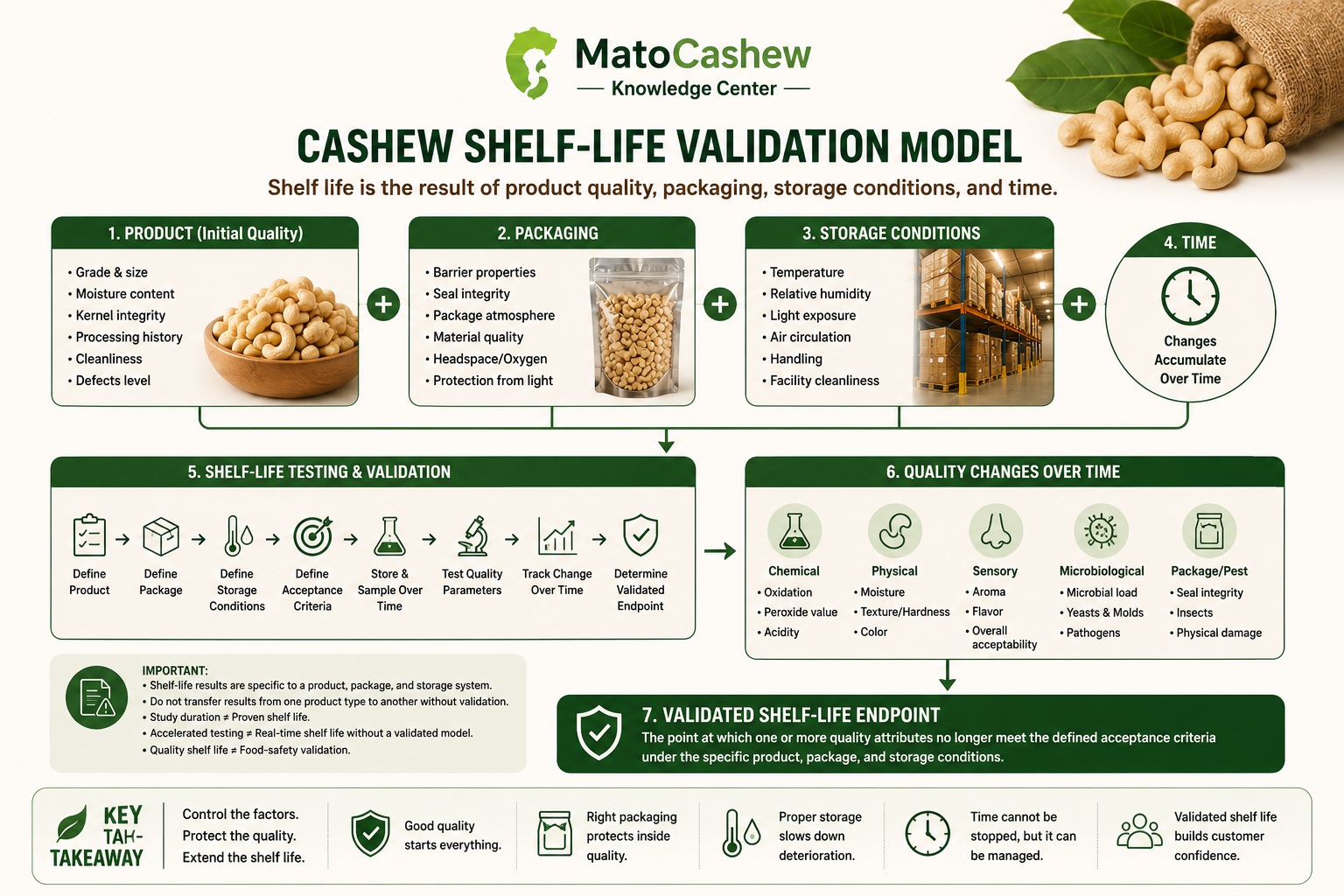
Conceptual shelf-life validation workflow. Actual study design, tests, acceptance criteria, sampling, storage conditions, and duration depend on the defined product, package, intended use, and applicable requirements.
A practical framework is:
- Define the product — product form, processing condition, specification, and starting quality.
- Define the package — materials, sealing system, atmosphere where relevant, and pack configuration.
- Define storage conditions — the environment or environments to be evaluated.
- Define acceptance criteria — what measurements or observations determine acceptable quality.
- Define the sampling plan — when and how samples will be evaluated.
- Test the product — use appropriate analytical, physical, sensory, microbiological, or package assessments.
- Track change over time — compare results against the defined starting condition and criteria.
- Determine the endpoint — establish the period supported by the evidence for that defined system.
Validate the Actual System
Shelf-life evidence is strongest when the study reflects the actual product, package, processing condition, intended storage environment, and acceptance criteria. Changing one of those elements may change the relevance of the result.
Real-Time vs Accelerated Testing
Real-time and accelerated studies can both provide useful information, but they answer different questions.
| Method | Principle | Important Limitation |
|---|---|---|
| Real-Time Testing | Follows the defined product/package system over actual time under defined intended or study conditions | Requires sufficient observation time to evaluate the intended period |
| Accelerated Testing | Uses elevated or stress conditions to produce quality changes more quickly | Accelerated time cannot automatically be converted into real-world months without an appropriate validated model |
Accelerated Days Do Not Automatically Equal Real-Time Months
A result obtained under elevated temperature or another stress condition cannot simply be converted into a commercial shelf-life duration by proportion. Any extrapolation requires an appropriate model, assumptions, and validation for the product being studied.
Quality Shelf Life vs Food Safety
Quality shelf life and food-safety validation are related parts of product management, but they are not interchangeable.
A product may become unacceptable because of aroma, flavour, texture, appearance, or another quality characteristic. That observation alone does not define every food-safety question.
Likewise, a product that still appears or tastes acceptable should not be assumed safe solely on the basis of sensory quality.
Quality Acceptance Does Not Replace Food-Safety Controls
Shelf-life evaluation should operate within an appropriate food-safety system. Hygienic processing, hazard controls, suitable packaging, traceability, storage controls, and applicable requirements remain necessary.
For the broader safety framework, see Cashew Food Safety.
Shelf Life vs Best-Before / Date Marking
A shelf-life study provides evidence. A commercial date marking is a separate decision that must also reflect the actual product and applicable market requirements.
A useful conceptual sequence is:
Shelf-Life Study → Product-Specific Evidence → Validated Shelf-Life Decision → Commercial Date Marking + Applicable Requirements
This distinction matters because a duration found in a research paper, general guide, or another manufacturer’s product should not simply be copied onto a package.
A Published Duration Is Not Automatically Your Best-Before Date
Commercial date marking should be supported by appropriate evidence for the actual product and should comply with the requirements that apply in the destination market. This guide does not replace product-specific validation or market-specific labeling requirements.
How to Protect Cashew Shelf Life
Shelf-life protection starts before the product enters storage.
A practical quality-preservation approach is to:
- Start with suitable product quality and processing condition.
- Establish and control the intended moisture condition.
- Select packaging appropriate to the product and distribution environment.
- Maintain reliable seals and package integrity.
- Control storage and distribution conditions.
- Protect the product from contamination, pests, damage, and unsuitable exposure.
- Maintain identification and traceability.
- Validate shelf life for the actual product/package/storage system.
These steps do not guarantee one universal duration. They create the controlled system needed to protect quality and generate meaningful shelf-life evidence.
Common Shelf-Life Mistakes
Common interpretation and management mistakes include:
- Copying a generic “X months” shelf-life figure without checking its context.
- Treating a study observation period as a proven commercial shelf life.
- Applying RCN results directly to processed kernels.
- Applying unroasted-kernel results directly to roasted or flavoured products.
- Assuming vacuum packaging guarantees a specific duration.
- Ignoring package punctures, leaks, or seal failures.
- Treating temperature as the only factor that matters.
- Converting accelerated test days directly into real-time months without validated modelling.
- Treating sensory acceptability as proof of food safety.
- Copying a published shelf-life duration directly into a best-before date.
- Ignoring changes in product formulation, package, or distribution conditions after validation.
Key Takeaways
- ✓Cashew shelf life belongs to a defined product, package, storage environment, and set of acceptance criteria.
- ✓Initial quality, moisture, oxygen exposure, packaging, temperature, humidity, handling, and time can interact.
- ✓Raw cashew nuts, processed kernels, roasted kernels, and flavoured products require separate interpretation.
- ✓Quality can change chemically, physically, sensorially, microbiologically, and through package or pest condition.
- ✓Study duration is not automatically the product's validated shelf life.
- ✓Accelerated testing cannot be converted directly into real-time months without appropriate modelling and validation.
- ✓Quality shelf life, food-safety validation, and commercial date marking should remain clearly distinguished.
Frequently Asked Questions
How long do cashew kernels last?
There is no single shelf-life duration that applies to every cashew kernel product. Actual shelf life depends on starting product condition, moisture, packaging, storage environment, product form, acceptance criteria, and validation for the defined product/package system.
Why is there no single shelf-life number for cashews?
Cashew products can differ in processing, moisture condition, packaging, storage exposure, formulation, and quality criteria. A duration supported for one defined system should not automatically be transferred to another.
What factors affect cashew shelf life?
Important factors include initial product quality, moisture condition, oxygen exposure, packaging and seal integrity, temperature, humidity, light, handling, product form, and time.
Does vacuum packaging give cashews a fixed shelf life?
No. Vacuum packaging can be part of a protective packaging system, but it does not by itself guarantee a specific duration. Product condition, material performance, seal integrity, storage conditions, and validation still matter.
Does refrigeration automatically establish a longer shelf life?
No fixed commercial duration should be assumed from refrigeration alone. Temperature can influence deterioration behaviour, but shelf life still depends on the defined product, package, storage conditions, and supporting evidence.
How does moisture affect cashew shelf life?
Moisture condition is one part of product stability. The condition established during processing must be protected against unwanted change through suitable packaging and storage. Moisture should be interpreted together with the product stage, measurement method, and storage environment.
What causes rancid flavour in cashews?
Oxidative deterioration of cashew oils can contribute to rancid or undesirable aromas and flavours. The rate and extent of change can be influenced by product condition, oxygen exposure, temperature, packaging, and time.
What is real-time shelf-life testing?
Real-time testing follows a defined product and package over actual time under defined storage conditions while measuring the acceptance criteria selected for the study.
What is accelerated shelf-life testing?
Accelerated testing uses elevated or stress conditions to make quality changes occur more quickly. Results can support stability evaluation, but accelerated days should not automatically be converted into real-world months without an appropriate validated model.
Is shelf life the same as a best-before date?
Not exactly. Shelf-life studies generate evidence for a defined product system. Commercial date marking is a separate decision that should use appropriate product-specific evidence and comply with applicable market requirements.
Is quality shelf life the same as food safety?
No. Quality shelf life may involve aroma, flavour, texture, appearance, or other acceptance characteristics. Food safety requires appropriate hazard controls and validation and should not be inferred only from sensory quality.
How should a processor validate cashew shelf life?
Define the actual product, package, storage conditions, acceptance criteria, sampling plan, and appropriate tests; then track relevant quality changes over time and determine an endpoint supported by the resulting evidence.