Cashew Packaging Guide
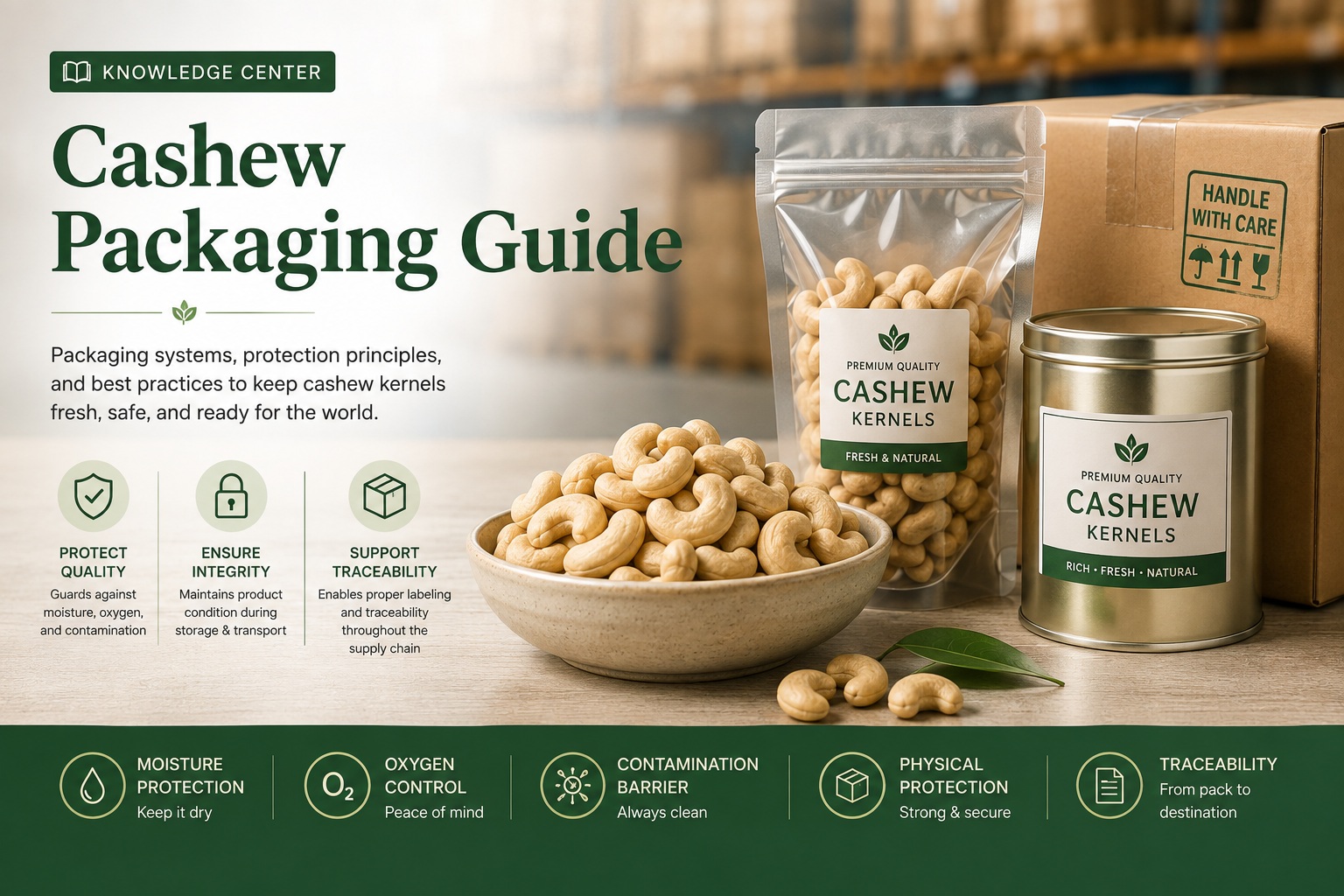
Packaging is the protection system that surrounds finished cashew kernels after processing, grading, and quality control. Its role goes beyond simply holding the product: suitable packaging helps protect kernels from unwanted moisture exchange, oxygen exposure, contamination, physical damage, and handling conditions during storage and distribution.
The right packaging system depends on the product, buyer, market, packing process, distribution environment, and applicable specification. A packaging requirement should therefore not be confused with one particular packaging technology or material.
Quick Facts
- ✓Packaging protects the quality and condition achieved during cashew processing and drying.
- ✓AFI and UNECE DDP-17 both include hermetic packaging provisions, but their scopes and detailed requirements are not identical.
- ✓Hermetic packaging and vacuum packaging are related concepts but are not the same thing.
- ✓Vacuum and gas-flushed packaging are options, not universal best solutions for every cashew product or market.
- ✓Moisture barrier, oxygen barrier, sealability, physical strength, and food-contact suitability are important packaging considerations.
- ✓Package integrity, identification, and traceability remain important throughout storage and distribution.
What Is Cashew Packaging?
Cashew packaging is the combination of materials, containers, seals, handling systems, and identification used to protect kernels after processing.
A good packaging system should support the intended product condition from packing through storage, transport, distribution, and final use. Depending on the supply chain, this may involve a product-contact package, an outer carton, and transport packaging.
Packaging should be understood in two different ways:
- Packaging requirements describe what the package must achieve.
- Packaging technologies describe ways those objectives may be achieved.
Requirement Does Not Mean One Universal Technology
A requirement for hermetic protection does not automatically prescribe one pouch, one material, vacuum packaging, or one gas composition. The selected system must satisfy the applicable specification, buyer, product, process, and distribution requirements.
Why Packaging Matters
Finished kernels remain sensitive to their surrounding environment. Packaging forms the interface between the product and that environment.
Important functions include:
- Limiting unwanted moisture exchange.
- Managing exposure to air or oxygen where required.
- Protecting against dust, foreign matter, and contamination.
- Reducing physical damage during handling and transport.
- Maintaining package and seal integrity.
- Supporting product identification and traceability.
- Helping preserve the condition achieved during processing and quality control.
Packaging therefore connects directly with cashew moisture control, storage management, and food-safety practices.
Understanding the Packaging System
Packaging can be viewed as a layered protection system.
Primary Packaging
Primary packaging directly contains or protects the cashew kernels. Its performance may involve food-contact suitability, barrier properties, sealing, atmosphere management, and contamination protection.
Secondary Packaging
Secondary packaging groups or protects primary packages. It can add mechanical protection and provide space for identification, handling information, or commercial labeling.
Transport Packaging
Transport packaging supports stacking, handling, shipment, and distribution. It helps protect the packaged product from physical stresses through the logistics chain.
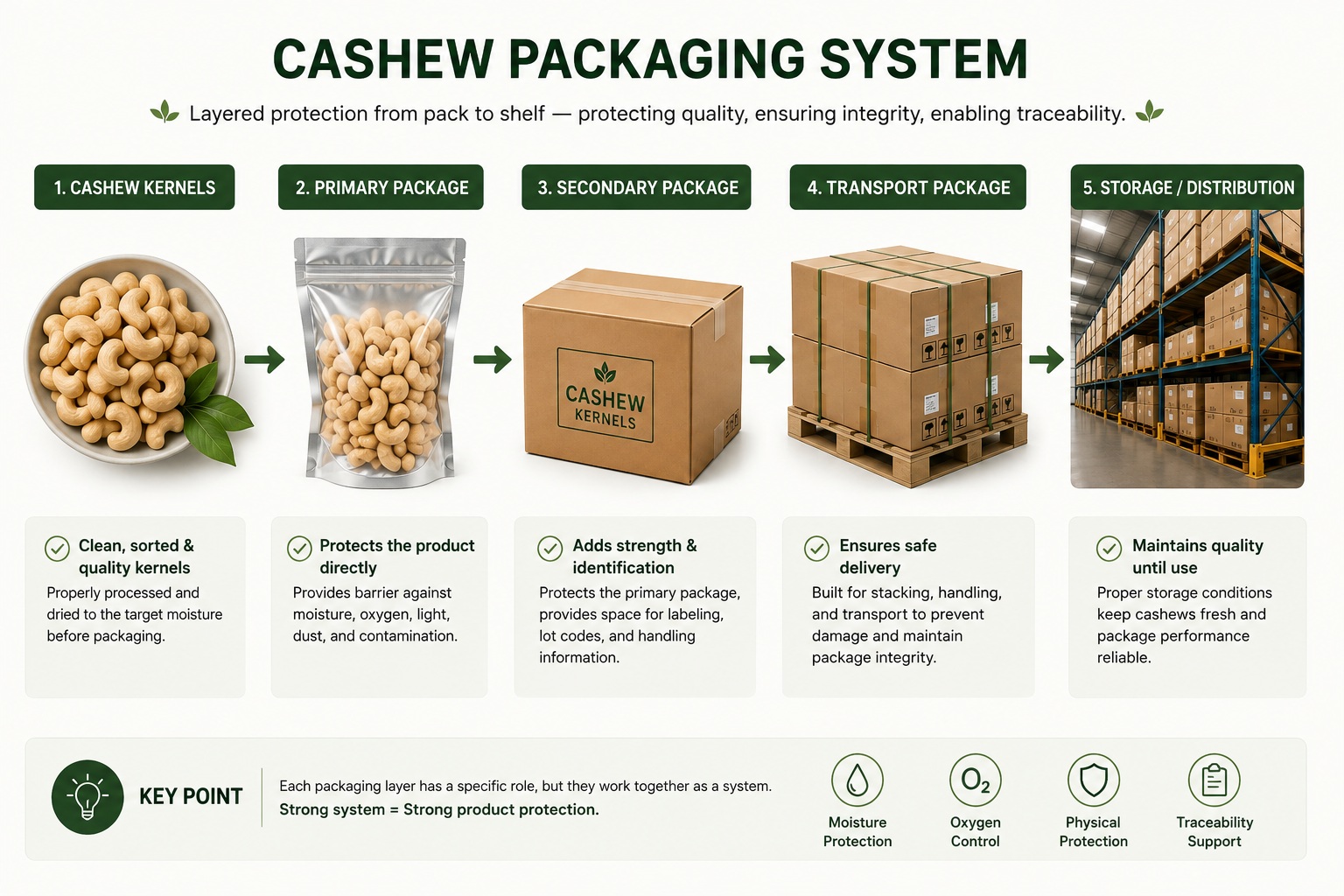
Conceptual packaging-system layers. The exact configuration depends on the product, buyer, market, packing process, and distribution requirements; not every supply chain uses three physically separate packaging layers.
What Good Cashew Packaging Must Achieve
The exact package can vary, but the protection objectives are consistent.
| Packaging Function | What It Helps Protect |
|---|---|
| Moisture Protection | Limits unwanted moisture exchange between kernels and the surrounding environment |
| Atmosphere / Oxygen Management | Helps control exposure to the internal and external package atmosphere where the system is designed to do so |
| Contamination Protection | Helps protect kernels from dust, foreign matter, and unsuitable external exposure |
| Physical Protection | Reduces damage from handling, compression, puncture, or transport |
| Seal Integrity | Maintains the intended protective package environment |
| Traceability | Supports identification of product, lot, packer, and other required information |
AFI and UNECE Packaging Requirements
Two important commercial references for cashew kernels contain packaging provisions: the Association of Food Industries (AFI) specification and UNECE DDP-17.
AFI Specifications
The AFI Specifications for Cashew Kernels, adopted in September 2023, apply to shipments to the United States.
AFI states that cashews shall be packed in new, clean, dry, leakproof, lead-free containers with an airtight or hermetic seal. Packaging must also have sufficient strength to protect product integrity during normal shipment and storage.
AFI includes additional provisions covering outer-container condition, gas use, carton marking, and lot traceability.
UNECE DDP-17
UNECE DDP-17 — Cashew Kernels (2023) states that cashew kernels must be packed so as to protect the produce properly. Materials used inside the package must be clean and of a quality that avoids external or internal damage.
UNECE also states that cashew kernels must be packed in hermetically sealed containers and addresses suitable printing and labeling materials.
How the References Differ
| Reference | Packaging Expectation | Scope / Interpretation |
|---|---|---|
| AFI | New, clean, dry, leakproof containers; airtight/hermetic seal; shipment-strength and additional packing provisions | AFI specification for shipments to the U.S.; detailed requirements should remain AFI-scoped |
| UNECE DDP-17 (2023) | Proper product protection; clean package materials; hermetically sealed containers | UNECE commercial and marketing quality context |
Do Not Merge the Specifications
AFI and UNECE overlap on important protection principles, including hermetic packaging, but they are not one universal packaging standard. The applicable buyer, contract, market, and regulatory requirements must still be checked.
Hermetic Packaging
A hermetically sealed package is designed to limit uncontrolled exchange between the package environment and the surrounding environment.
For cashew kernels, this concept is important because finished product needs protection from moisture exchange, contamination, and unnecessary environmental exposure during storage and shipment.
The effectiveness of a hermetic system depends heavily on seal integrity. A high-performance barrier material cannot provide the intended protection if the seal is incomplete, damaged, punctured, or leaking.
Hermetic Is Not the Same as Vacuum
Hermetic describes the sealed protection of the package. Vacuum describes a process in which air is reduced before sealing. A package can be hermetically sealed without being vacuum packed.
Vacuum Packaging
Vacuum packaging reduces the amount of air inside a package before it is sealed. It can be used as part of an atmosphere-control strategy and has been used in cashew packaging.
However, vacuum should not be treated as the automatically superior choice for every product.
Suitability depends on factors such as:
- Kernel condition before packing.
- Package material and barrier performance.
- Seal quality.
- Vacuum level and packing process.
- Physical effects on the kernels.
- Storage and transport conditions.
- Shelf-life objective.
- Buyer and market requirements.
AFI also defines blocking as bonding of kernels in the presence of high moisture and high vacuum pressure. This illustrates why product condition and packaging conditions must be considered together.
Gas-Flushed and Modified-Atmosphere Packaging
Gas-flushed or modified-atmosphere packaging changes the gas environment inside the sealed package. One purpose can be to manage oxygen exposure and support quality preservation.
Gas composition, however, should never be generalized across every cashew market or packaging operation.
Within its own specification, AFI states that only food-grade carbon dioxide is permitted, at a minimum mixture of 60% CO2, with the balance nitrogen.
AFI Gas Requirements Are Scope-Specific
The AFI CO2/N2 provision belongs to the AFI specification for U.S. shipments. It should not be rewritten as a global requirement that every cashew package must use the same gas mixture, nor does it mean cashews must always be nitrogen flushed.
Comparing Packaging Systems
| System | Main Function | Important Consideration |
|---|---|---|
| Hermetic | Limits uncontrolled exchange between the sealed package and external environment | Seal integrity is essential |
| Vacuum | Reduces air inside the package before sealing | Must suit the product, material, process, and distribution conditions |
| Gas-Flushed / MAP | Creates a controlled internal package atmosphere | Gas composition depends on the applicable process, specification, and market |
| Barrier Package / Container | Provides moisture, oxygen, contamination, and/or physical protection according to its design | Material performance and sealing must match the intended use |
These systems are not mutually exclusive. For example, a packaging material can provide barrier protection while the finished package is also hermetically sealed and uses a controlled internal atmosphere.
Packaging Materials and Barrier Properties
Rather than looking for one universally correct packaging material, processors should consider the performance required from the complete package.
Important properties include:
Moisture Barrier
The package should provide the level of protection needed to limit unwanted moisture exchange during the intended storage and distribution period.
Oxygen Barrier
Where oxidative quality is a concern, package design may need to control oxygen exposure as part of the overall preservation system.
Sealability
A barrier package depends on a reliable seal. Material selection and sealing equipment must work together.
Mechanical Strength
Packages may need resistance to puncture, tearing, compression, stacking, and other handling stresses.
Process Compatibility
The material and container must be compatible with the selected packing process, including vacuum or gas flushing where those technologies are used.
Food-Contact Suitability
Product-contact materials must be suitable for their intended food use and comply with applicable market and regulatory requirements.
There Is No Universal Cashew Laminate
A specific film structure, plastic grade, pouch, or rigid container should not be presented as the best solution for every cashew product. Material selection depends on the required barrier performance, packing technology, distribution environment, buyer requirements, and applicable food-contact rules.
Moisture and Oxygen Protection
Moisture and oxygen are two important environmental factors that packaging may help manage.
Finished kernel moisture is established through processing and drying. Packaging then helps protect that condition by limiting unwanted exchange with the surrounding environment. For the specification and measurement context, see the Cashew Moisture Standards.
Cashew kernels also contain oils that can undergo oxidative deterioration. Package design can influence oxygen exposure, but packaging is only one part of quality preservation. Product condition, temperature, storage time, light exposure, package integrity, and other factors can also matter.
Packaging therefore supports shelf-life performance, but a packaging technology alone does not establish a guaranteed shelf life.
Packaging Hygiene and Food Safety
Packaging should protect kernels without becoming a source of contamination.
Important controls include:
- Clean packaging materials and containers.
- Suitable product-contact materials.
- Protection from dust, pests, foreign matter, and unsanitary handling.
- Inspection for punctures, leaks, contamination, or other damage.
- Suitable printing, labeling, and adhesive materials where applicable.
- Hygienic handling during filling, sealing, and packing.
These controls complement rather than replace the broader hygiene and hazard-management practices explained in the Cashew Food Safety guide.
Package Integrity During Storage and Transport
A package must remain functional after it leaves the packing line.
Common threats to integrity include:
- Weak or incomplete seals.
- Punctures and tears.
- Crushing or excessive compression.
- Poor stacking.
- Water or unsuitable environmental exposure.
- Rough handling.
- Pest damage.
- Damaged cartons or transport packaging.
Regular inspection helps identify problems before they affect more product. Storage conditions must also support the packaging system rather than work against it.
For warehouse conditions, humidity, temperature, pest control, and stock management, see the Cashew Storage Guide.
Labeling and Traceability
Packaging also carries information needed to identify and trace the product.
Depending on the applicable specification, buyer, and market, information may include:
- Product or trade identification.
- Producer or packer.
- Grade.
- Net or gross weight.
- Country of origin.
- Lot, production, or date code.
- Allergen information.
- Buyer/seller-agreed marks.
AFI includes detailed carton-marking and packing-list traceability provisions within its U.S.-shipment specification.
Labeling Requirements Depend on the Market
This guide explains packaging and traceability principles, not country-by-country labeling law. Exporters should verify the legal, buyer, contract, and destination-market requirements that apply to each shipment.
Retail vs Bulk and Commercial Packaging
Retail and bulk packaging share the goal of protecting the product, but their operational priorities can differ.
| Packaging Context | Typical Priorities |
|---|---|
| Bulk / Commercial | Barrier and seal performance, transport protection, package strength, lot identification, traceability, buyer and specification requirements |
| Retail | Product protection plus consumer presentation, portioning, convenience, resealability where needed, and applicable retail labeling |
Neither format has one universal design. The correct system depends on how the product will be packed, sold, handled, stored, and transported.
How to Choose a Packaging System
A packaging decision should be based on the complete product and supply-chain context.
Consider:
- Product form and condition — What is being packed and what condition must be protected?
- Applicable specification — What does the buyer, contract, standard, or market require?
- Shelf-life objective — What performance must the complete product/package/storage system achieve?
- Barrier needs — How much moisture and oxygen protection is required?
- Packing technology — Will the system use ambient sealing, vacuum, gas flushing, or another process?
- Storage and distribution — What temperatures, humidity, handling, stacking, and transport stresses are expected?
- Package integrity — Can the material and seal withstand the intended supply chain?
- Food-contact and regulatory requirements — Are the materials suitable and compliant for the intended market?
- Operational practicality — Can the system be consistently packed, inspected, handled, and traced?
The goal is not to select a technology because it sounds more advanced. The goal is to choose a packaging system that reliably meets the product’s actual requirements.
Common Packaging Mistakes
Common problems include:
- Treating hermetic and vacuum packaging as the same thing.
- Assuming cashews must always be nitrogen flushed.
- Applying one market’s packaging specification globally.
- Using a high-barrier material with a weak or unreliable seal.
- Ignoring kernel condition or moisture before packing.
- Selecting materials without considering transport and handling stresses.
- Allowing punctured, leaking, wet, or damaged packages to remain in use.
- Failing to maintain clear lot identification and traceability.
- Assuming packaging alone guarantees shelf life.
- Choosing packaging based only on appearance rather than performance and compliance.
Key Takeaways
- ✓Cashew packaging is a complete protection system, not simply a container.
- ✓AFI and UNECE DDP-17 both include hermetic packaging provisions but must be interpreted within their own scopes.
- ✓Hermetic, vacuum, gas-flushed, and barrier packaging describe different functions or technologies and should not be treated as interchangeable.
- ✓Barrier performance and seal integrity must work together.
- ✓Packaging selection depends on product condition, buyer and market requirements, shelf-life objectives, equipment, storage, and distribution.
- ✓Packaging supports moisture, oxygen, contamination, physical protection, and traceability but does not by itself guarantee shelf life.
Frequently Asked Questions
What packaging is used for cashew kernels?
Cashew kernels can be packed in different flexible or rigid systems depending on the product, buyer, market, packing technology, and distribution requirements. Commercial specifications such as AFI and UNECE DDP-17 include hermetic packaging provisions, but they do not establish one universal package format for every use.
Do cashews need hermetic packaging?
Both the AFI Specifications for Cashew Kernels and UNECE DDP-17 include hermetic packaging provisions within their respective scopes. The exact package design and other requirements still depend on the applicable specification, buyer, market, and packing process.
Is hermetic packaging the same as vacuum packaging?
No. Hermetic describes a sealed package designed to limit uncontrolled exchange with the external environment. Vacuum packaging reduces air in the package before sealing. A package can be hermetically sealed without being vacuum packed.
Is vacuum packaging the best option for cashews?
Not universally. Vacuum packaging can be useful, but suitability depends on kernel condition, package material, seal quality, packing process, storage and transport conditions, shelf-life objectives, and buyer or market requirements.
Should cashews always be nitrogen flushed?
No universal rule requires every cashew package to be nitrogen flushed. Gas composition depends on the applicable packaging process and specification. AFI has a specific CO2/N2 provision for shipments within its scope, which should not be generalized to every market.
What is modified-atmosphere packaging?
Modified-atmosphere or gas-flushed packaging changes the gas environment inside a sealed package. It may be used to manage oxygen exposure or other package-atmosphere conditions, but the appropriate gas composition and process depend on the product and applicable requirements.
What properties should cashew packaging materials have?
Relevant properties can include moisture and oxygen barrier performance, sealability, puncture and mechanical strength, compatibility with the packing process, and suitability for food contact. The required balance depends on the intended product and supply chain.
How does packaging protect cashews from moisture?
Suitable barrier materials and intact seals help limit moisture exchange between kernels and the surrounding environment. Packaging works together with proper kernel moisture and storage conditions rather than replacing those controls.
What is the difference between bulk and retail cashew packaging?
Bulk or commercial packaging commonly emphasizes transport protection, barrier and seal performance, package strength, traceability, and buyer specifications. Retail packaging may add consumer presentation, portioning, convenience, resealability, and market-specific labeling requirements.
Does packaging determine cashew shelf life?
Packaging influences shelf-life performance but does not determine it alone. Product condition, moisture, oxygen exposure, seal integrity, temperature, humidity, handling, storage time, and other factors also affect how long quality can be maintained.