Cashew Kernel Grades & Uses
Choosing a cashew kernel grade is not simply a matter of finding the largest kernel or the lowest W-number. A commercial cashew specification can combine kernel form, size, quality class, technical requirements, processing performance, packaging, and buyer requirements.
The useful buyer question is therefore not:
“Which cashew grade is the best?”
It is:
“Which combination of form, size, quality, and technical requirements best fits the intended application and buyer specification?”
This guide explains that selection process while keeping size and quality as separate concepts.
Quick Facts
- ✓Kernel form, kernel size, and quality class are different parts of a cashew specification.
- ✓Whole, butt, split, and piece kernels serve different presentation and processing needs.
- ✓For whole kernels, a lower count per unit weight generally means larger individual kernels.
- ✓A larger whole kernel is not automatically higher quality or better for every application.
- ✓Common whole-kernel size designations include 180, 210, 240, 320, and 450, but specifications can include other codes.
- ✓UNECE and AFI use different quality and piece-grade terminology and should not be treated as directly equivalent.
- ✓The right commercial grade is the one that meets the agreed buyer specification—not simply the largest size.
What Are Cashew Kernel Grades?
Cashew grading is a way of describing and separating kernels according to defined characteristics. In commercial use, a product description can involve more than one dimension.
A buyer may need to identify:
- the kernel form;
- the whole-kernel size or piece-size category;
- the quality class or condition;
- technical requirements such as moisture;
- processing or end-use expectations;
- packaging and market requirements.
For the full technical grading framework, definitions, and classification context, see Cashew Grading Standards.
Grade, Size, and Quality Are Different
A common source of confusion is treating a size designation as if it were a complete quality grade.
A better model is:
Kernel Form + Size + Quality Class + Technical Specification = Commercial Product Specification
Size Designation Is Not the Same as Quality Class
A W-number or whole-kernel count mainly helps describe size. It does not by itself establish colour quality, defect level, food-safety status, taste, processing performance, or overall suitability for a buyer.
For example, a larger whole kernel can still fail a buyer’s requirements for colour, defects, moisture, or other characteristics. A smaller whole kernel that meets the complete specification may be the more suitable commercial choice.
How Cashew Grade Names Work
Commercial cashew descriptions often combine letters, names, and numbers.
For whole kernels, the numerical designation is associated with a kernel-count range under the applicable specification. Lower counts per unit weight generally correspond to larger individual kernels.
Other terms identify kernel form or condition. Depending on the specification, buyers may encounter terms for:
- whole kernels;
- butts;
- splits;
- pieces;
- colour or quality classes;
- specific piece-size categories.
Because terminology is not identical across every standard or buyer specification, the reference specification should always be identified.
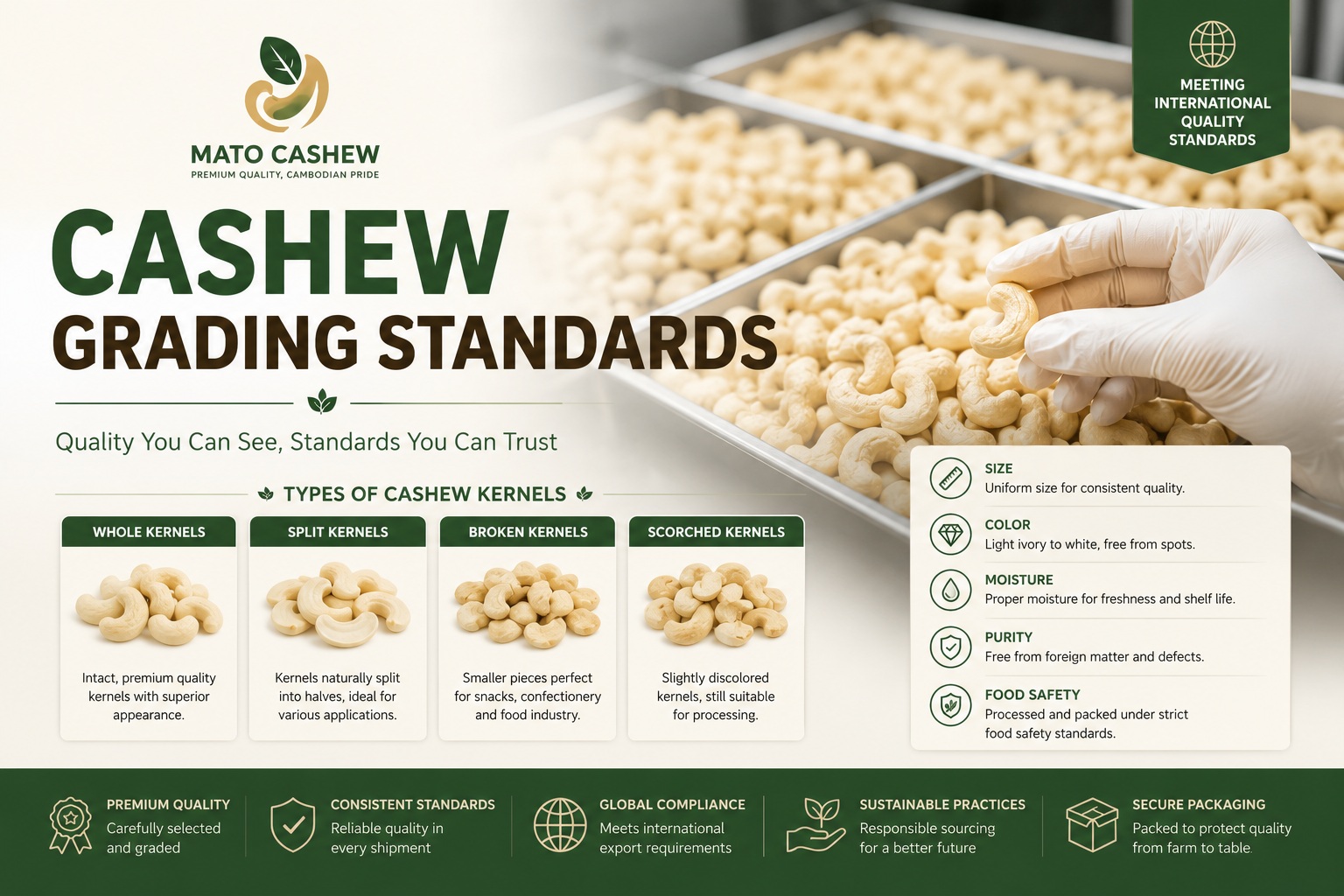
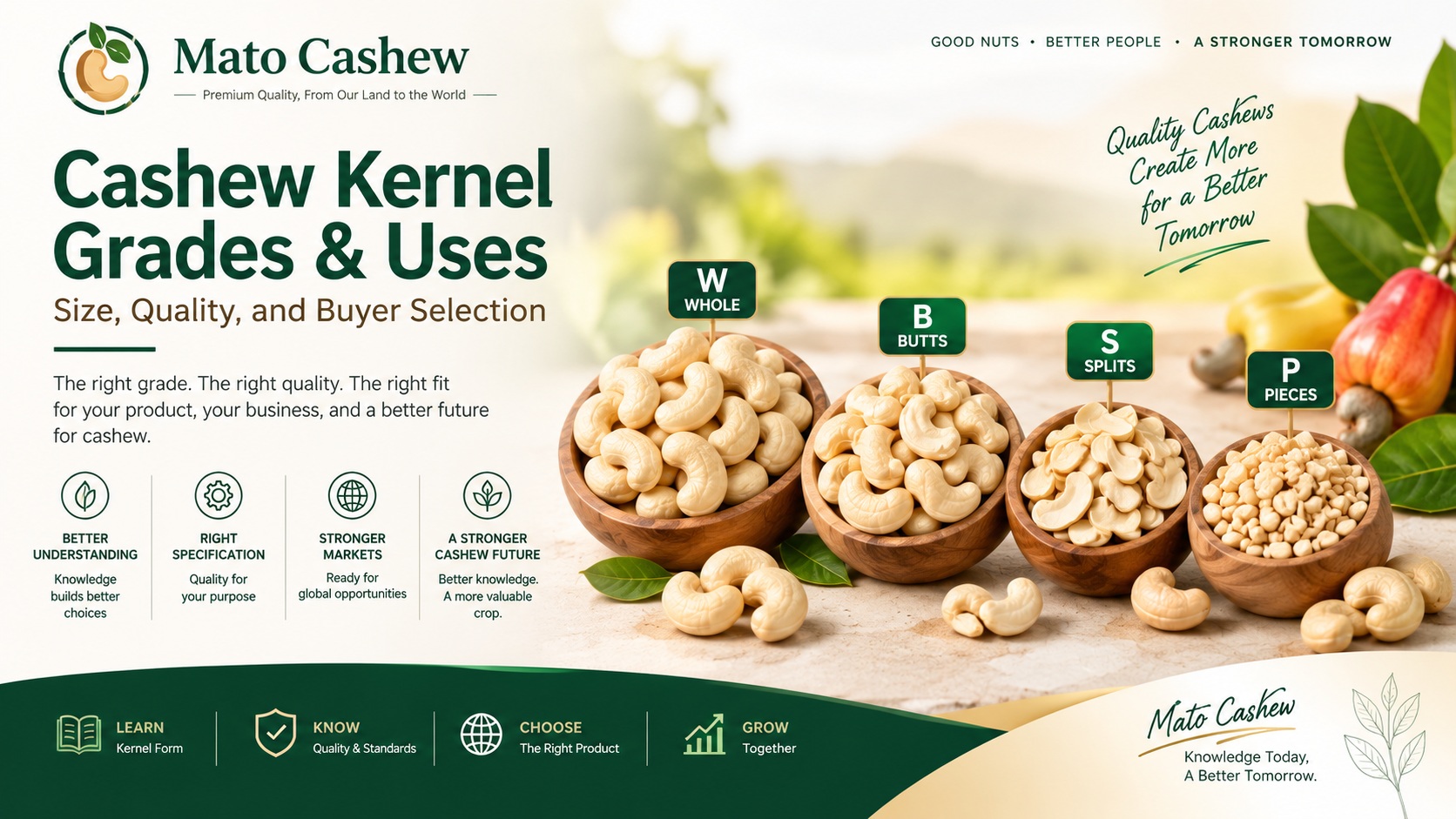
Kernel Form
Before selecting a whole-kernel size, determine whether the application actually requires whole kernels.
| Kernel Form | General Description | Selection Consideration |
|---|---|---|
| Whole | Kernel retaining its characteristic whole form within the applicable specification | Consider when intact-kernel presentation is important |
| Butt | Kernel broken across its width | Consider when a defined larger broken form meets the buyer or processing need |
| Split | Kernel split lengthwise into an approximately half-kernel form | Consider when a defined split presentation is suitable |
| Piece | Kernel broken into specified smaller pieces | Consider when controlled ingredient-piece size matters more than intact presentation |
Kernel form should therefore be selected according to the intended presentation or processing requirement—not as a simple best-to-worst ranking.
Understanding Whole-Kernel Size Codes
Common commercial whole-kernel designations include 180, 210, 240, 320, and 450. Other codes can also appear depending on the specification; UNECE DDP-17, for example, includes additional whole-size codes.
The following count ranges use the AFI specification context as examples.
| Designation | Approx. Count per lb | Relative Size Context | Buyer-Selection Meaning |
|---|---|---|---|
| 180 | 140–180 | Very large whole | Consider when a larger intact presentation is specified |
| 210 | 180–210 | Large whole | Selection depends on the buyer and intended application |
| 240 | 220–240 | Large whole | Selection depends on the required size and commercial specification |
| 320 | 300–320 | Medium whole within common commercial sizing | Select by specification rather than treating it as a quality ranking |
| 450 | 400–450 | Smaller whole | Consider where a smaller whole size meets the requirement |
The basic relationship is straightforward:
Lower count per unit weight → generally larger individual whole kernels
Higher count per unit weight → generally smaller individual whole kernels
The count should still be interpreted under the specification being used.
Larger Does Not Automatically Mean Higher Quality
Kernel size can matter commercially, but it is only one characteristic.
Larger Does Not Automatically Mean Better
A larger kernel is not automatically better in colour, lower in defects, safer, better tasting, more suitable for processing, or more appropriate for every buyer. Size should be evaluated together with the complete quality and technical specification.
This distinction is especially important when comparing designations such as W240 and W320. A buyer should not assume that the lower number automatically represents a higher overall quality class.
Quality Classes and Condition
Quality classification considers characteristics beyond size.
Depending on the applicable specification, these can include:
- colour;
- defects;
- damage;
- tolerances;
- condition;
- other defined quality characteristics.
UNECE DDP-17 uses quality classes such as Extra, Class I, and Class II.
AFI uses a different terminology framework that includes categories such as First Quality Fancy, Second Quality Scorched, Third Quality Special Scorched, Lightly Blemished, and other defined categories.
For a broader discussion of defects, acceptance, and product quality, see Cashew Quality Standards.
UNECE and AFI Terminology
UNECE and AFI can both be useful commercial references, but their terminology and scope should remain distinct.
| Dimension | UNECE DDP-17 | AFI |
|---|---|---|
| Quality terminology | Extra, Class I, Class II | Includes First Quality Fancy, Second Quality Scorched, Third Quality Special Scorched, Lightly Blemished, and other categories |
| Whole-size context | Includes size codes such as 150, 180, 210, 240, 320, 450, and 500 | Common U.S.-market specification context includes 180/SLW, 210/LW, 240, 320, and 450 |
| Piece terminology | Uses UNECE-defined piece categories | Uses AFI-defined piece categories and sieve-based definitions for several categories |
| Selection rule | Apply the UNECE specification as written where relevant | Apply the AFI specification as written where relevant |
Do Not Assume UNECE and AFI Classes Are Directly Equivalent
Similar commercial purposes do not establish a one-to-one equivalence between quality classes or piece categories. Use the terminology, definitions, tolerances, and scope of the specification actually agreed for the transaction.
Understanding Piece Grades
Piece sizing is useful when a manufacturing or ingredient application needs controlled broken-kernel dimensions rather than intact whole-kernel presentation.
However, piece terminology is not universal.
UNECE includes piece categories such as Large Pieces, Small Pieces, Very Small Pieces, and Baby Bits/Granules.
AFI uses a more detailed taxonomy that includes categories such as Large Pieces, Small Pieces, Chips, Baby Bits, Fine Grains, Fines, and Mixed Pieces, with sieve-based definitions for several categories.
Piece Names Must Be Read With Their Specification
Do not assume that a piece name has exactly the same size definition in every commercial standard. The applicable standard or buyer specification should define the required category and size.
Choosing by Intended Application
Start with the function the kernel must perform in the buyer’s product or process.
| Application Need | Selection Consideration |
|---|---|
| Intact visual presentation | Consider whole kernels and then select the required whole size and quality specification |
| Larger whole appearance | Consider an appropriate lower-count whole size, subject to buyer specification |
| Smaller whole appearance | Consider an appropriate higher-count whole size where it meets the commercial requirement |
| Defined half or larger broken form | Consider a split or butt specification |
| Controlled ingredient pieces | Select a piece-size category defined by the applicable specification |
| Appearance-critical application | Evaluate form and size together with colour, defects, tolerances, and quality class |
| Manufacturing consistency | Define kernel form and size requirements clearly rather than relying on a general grade name alone |
This approach is more reliable than assigning one W-number to one fixed food application.
Choosing by Presentation Requirement
When the finished product displays the cashew visibly, presentation may influence the selection.
A buyer may consider:
- whether kernels should remain whole;
- the preferred relative whole size;
- visual consistency;
- colour;
- allowable defects;
- breakage;
- the appearance expected after further processing.
A requirement for large intact kernels is therefore different from a requirement for high quality in general. Both can be specified, but they should not be confused.
Choosing by Manufacturing Requirement
For manufacturing applications, the required form may be more important than preserving every kernel whole.
A processor may need:
- a controlled split or broken form;
- a defined piece-size range;
- consistent ingredient dimensions;
- predictable behaviour during further processing.
AFI’s use of sieve-based piece definitions illustrates why controlled piece sizing can matter for manufacturing consistency.
The correct choice should still come from the buyer’s intended process and specification rather than a universal rule such as “this grade is always for bakery” or “that grade is always for confectionery.”
Choosing by Quality Requirement
Once form and size are defined, the buyer should specify the quality characteristics that matter.
These can include:
- colour or quality class;
- allowable defects;
- tolerances;
- foreign matter limits where applicable;
- moisture;
- food-safety requirements;
- other contract-specific characteristics.
A complete purchase specification therefore needs more information than a W-number alone.
Considering Performance After Processing or Roasting
Raw appearance may not tell the entire story when the buyer intends to roast or further process the kernels.
AFI roast-test guidance supports evaluating appearance after roasting as part of quality assessment. For an application where roasting performance matters, a buyer may therefore need to consider:
- colour after processing;
- appearance consistency;
- breakage sensitivity;
- other end-use performance requirements.
This does not mean that one whole-kernel size automatically roasts better than another. Process performance should be evaluated as a separate requirement.
Buyer Selection Framework
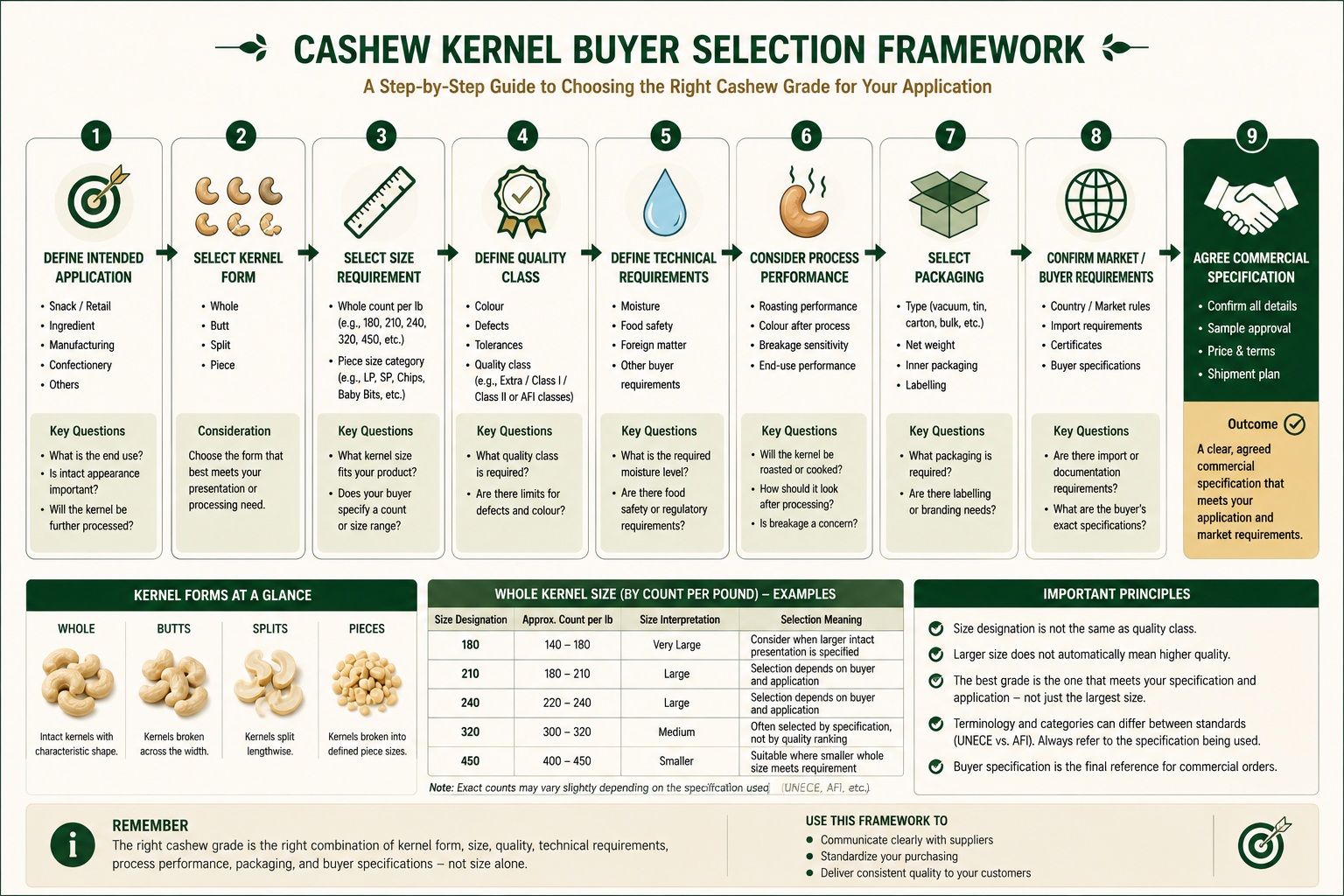
Conceptual buyer-selection framework. The suitable cashew specification depends on intended use, kernel form, size, quality, technical requirements, processing needs, packaging, and buyer or market requirements.
A practical selection sequence is:
- Define the intended application — determine the end use and presentation need.
- Select kernel form — whole, butt, split, or piece.
- Select the size requirement — whole-kernel count or specified piece-size category.
- Define the quality class — colour, defects, tolerances, and applicable quality terminology.
- Define technical requirements — moisture, food safety, and other buyer specifications.
- Consider process performance — including performance after roasting or further processing where relevant.
- Select packaging — according to product protection and commercial needs.
- Confirm buyer and market requirements — including any applicable market-specific requirements.
- Agree the commercial specification — ensure both seller and buyer use the same definitions and acceptance criteria.
The Best Grade Is the Grade That Fits the Complete Specification
Commercial selection should combine form, size, quality, technical requirements, processing needs, packaging, and buyer requirements. Size alone is not enough.
Grade + Moisture + Quality + Packaging
A commercial order can be understood as a combination of connected specifications:
Kernel Form + Size + Quality + Moisture + Food Safety + Packaging + Buyer Requirements
Moisture should be specified and interpreted in the context of the applicable commercial requirement. For detailed measurement and standards context, see Cashew Moisture Standards.
Packaging should then protect the agreed product condition through storage, transport, and distribution. For packaging systems and protection principles, see the Cashew Packaging Guide.
Commercial and Export Specification
For an international order, product selection also needs to fit the commercial and destination context.
A buyer and seller may need to agree on:
- product and kernel form;
- size designation;
- quality class;
- technical requirements;
- quantity;
- packaging;
- marking;
- testing or inspection where applicable;
- shipment and other commercial requirements.
These product-selection decisions are only one part of export readiness. For the broader framework covering documents, destination requirements, logistics, and traceability, see the Cashew Export Guide.
Common Grade-Selection Mistakes
Common mistakes include:
- Treating W180 as automatically the “best” cashew.
- Treating W320 as a universal quality level rather than a size designation within a specification.
- Assuming a larger whole kernel always means higher overall quality.
- Assigning one fixed food application to each W-number.
- Ignoring whether the application actually needs whole, split, butt, or piece kernels.
- Assuming UNECE and AFI quality classes are directly interchangeable.
- Treating piece names as if their definitions were identical across specifications.
- Choosing by size while ignoring colour, defects, tolerances, or moisture.
- Ignoring performance after roasting or further processing when it matters to the buyer.
- Ordering by a short grade name without confirming the complete buyer specification.
Key Takeaways
- ✓Start with the intended application, not with a preferred W-number.
- ✓Choose kernel form before deciding whether a whole-kernel size code is relevant.
- ✓Lower whole-kernel counts generally indicate larger individual kernels, but larger does not automatically mean higher quality.
- ✓Quality class, colour, defects, and tolerances must be considered separately from size.
- ✓UNECE and AFI terminology should remain tied to their own specifications rather than being treated as directly equivalent.
- ✓Piece-size terminology can differ between specifications, so buyers should define the applicable category clearly.
- ✓The final commercial specification should combine form, size, quality, technical requirements, packaging, and buyer or market needs.
Frequently Asked Questions
What does W320 mean in cashew grading?
W320 is a whole-kernel size designation used in commercial cashew grading. In the AFI specification context, it corresponds to approximately 300–320 kernels per pound. It describes size/count and should not be treated as a complete quality class.
Is W240 better quality than W320?
Not automatically. W240 generally represents a larger whole kernel than W320, but overall quality also depends on colour, defects, tolerances, condition, moisture, food-safety requirements, and the applicable buyer specification.
Does a lower cashew grade number mean a larger kernel?
For common whole-kernel count designations, a lower count per unit weight generally corresponds to larger individual kernels. The exact count range should be checked against the specification being used.
What is the difference between whole, butt, split, and piece cashews?
Whole kernels retain their characteristic whole form. Butts are broken across the width, splits are separated lengthwise into approximately half-kernel forms, and pieces are smaller broken kernels categorized by the applicable size specification.
Which cashew grade is best?
There is no single best grade for every buyer. The suitable choice depends on intended application, kernel form, size, quality requirements, technical specification, processing needs, packaging, and commercial requirements.
Which grade should a buyer choose when intact presentation is important?
Whole kernels should generally be considered when intact presentation matters. The buyer should then define the required whole size, quality class, colour, defects, tolerances, and other technical requirements.
Are W grades the same as quality classes?
No. W-number designations primarily describe whole-kernel size/count. Quality classification addresses other characteristics such as colour, defects, tolerances, and condition.
Are UNECE and AFI cashew grades equivalent?
They should not be assumed to be directly equivalent. UNECE and AFI use different terminology and specification structures. Use the definitions and tolerances of the reference actually agreed for the transaction.
Why do cashew piece-grade names differ?
Commercial specifications do not use identical piece taxonomies. UNECE and AFI, for example, define piece categories differently, so the buyer should identify the applicable specification and size definition.
Are cashew grades tied to fixed food applications?
No universal fixed mapping should be assumed. Selection should start with functional needs such as intact presentation, required whole size, broken form, controlled piece size, quality, and manufacturing consistency.
Does roasting performance matter when choosing cashews?
It can matter when roasting is part of the intended process. Evaluation may include appearance or other performance after roasting, but a W-number alone does not establish roasting performance.
What should a buyer include in a cashew specification?
A useful specification can include kernel form, size or piece category, quality class, colour and defect tolerances, moisture and food-safety requirements, processing expectations where relevant, packaging, quantity, and other agreed commercial requirements.