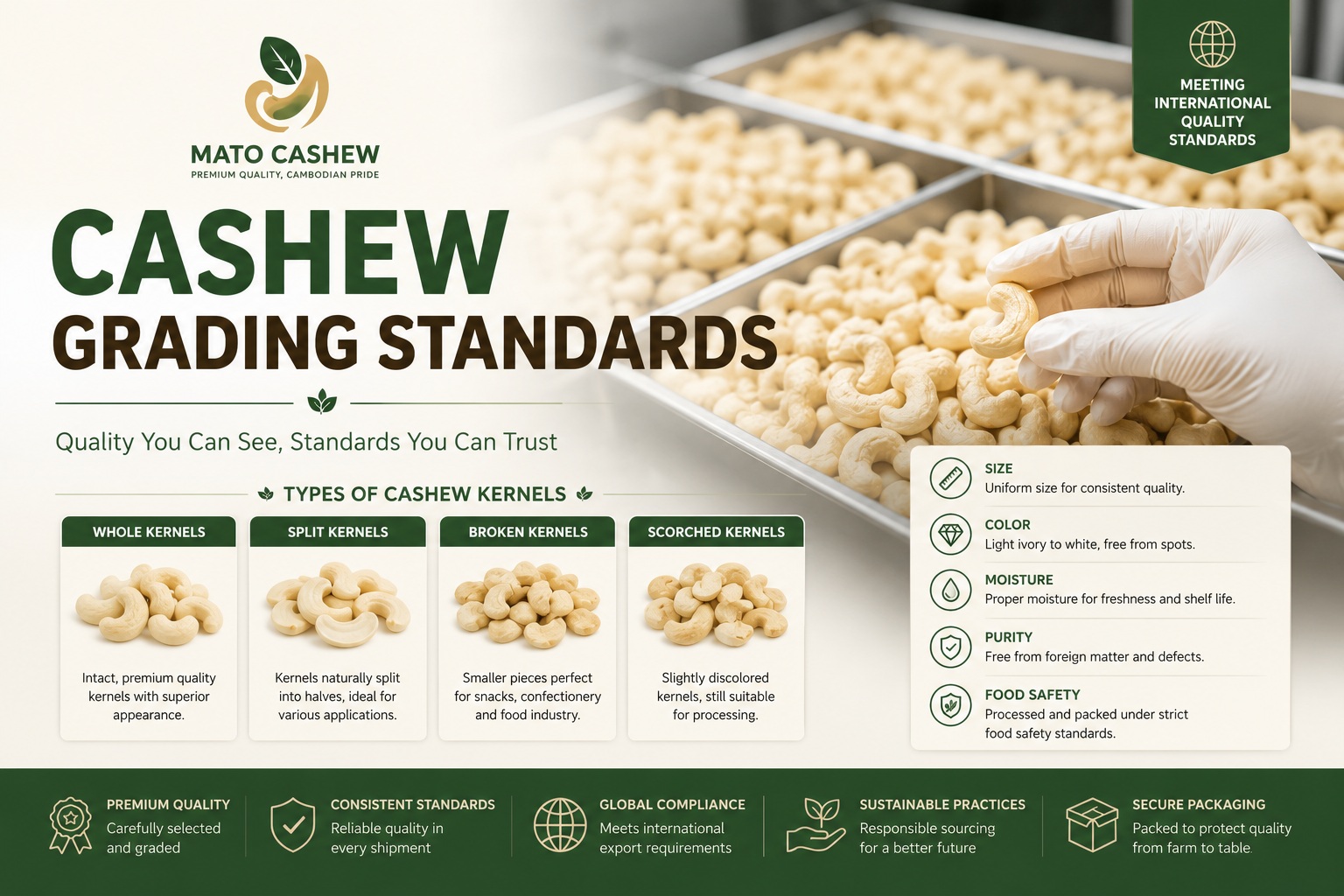
Cashew Grading Standards
Understanding cashew grading is essential for anyone involved in buying, selling, exporting, or processing cashew kernels.
International grading standards provide a common language that allows producers, exporters, importers, and food manufacturers to communicate product quality consistently across global markets.
Whether you are purchasing premium whole kernels for retail packaging or selecting ingredients for food manufacturing, understanding the grading system helps you choose the right product for your needs.
Quick Facts
- Cashew kernels are graded after shelling, peeling, drying, and quality inspection.
- Grades are determined by color, shape, size, and quality.
- The grade number represents the approximate number of kernels per pound.
- Lower grade numbers generally indicate larger kernels.
- WW320 is one of the most widely traded export grades worldwide.
Why Cashew Grading Matters
Cashew grading creates a standardized system that ensures buyers and sellers have the same expectations regarding kernel quality.
Without international grading standards, every exporter could describe products differently, making global trade inefficient and inconsistent.
A standardized grading system helps:
- Maintain consistent product quality
- Simplify international trade
- Support fair pricing
- Reduce misunderstandings between buyers and suppliers
- Improve food quality assurance
It also enables buyers to compare products from different suppliers using the same internationally recognized grading terminology.
How Cashew Grading Works
International cashew grading follows a structured classification system that describes each kernel using three key characteristics:
- Color
- Shape
- Size
Together, these characteristics form the grade code used throughout the global cashew industry.
Understanding Grade Codes
Every cashew grade is a combination of:
Color + Shape + Size
For example:
WW320 = White + Whole + 300–320 kernels per pound
1. Color Classification
Color indicates the visual appearance of the kernel after processing.
The three most common classifications are:
| Code | Meaning | |
|---|---|---|
| WW180 | 140–180 | Largest premium kernels |
| WW210 | 180–210 | Large premium kernels |
| WW240 | 220–240 | Premium retail grade |
| WW320 | 300–320 | Most common export grade |
| WW450 | 400–450 | Cost-effective whole kernels |
| WW500 | 450–500 | Small whole kernels |
White kernels are considered the premium appearance, while scorched kernels have a slightly darker color caused during processing. Dessert grades include kernels with more noticeable color variations but remain suitable for many food applications.
2. Shape Classification
Shape describes the physical condition of the kernel after shelling and peeling.
| Code | Meaning |
|---|---|
| W | Whole |
| B | Butts |
| S | Splits |
| P | Pieces |
Whole kernels command the highest value because they have the best appearance, while splits and pieces are widely used in food manufacturing and ingredient processing.
3. Size Classification
Whole kernels are further classified according to the approximate number of kernels per pound (454 g).
A lower number means a larger kernel.
For example:
- WW180 → Approximately 140–180 kernels per pound
- WW210 → Approximately 180–210 kernels per pound
- WW240 → Approximately 220–240 kernels per pound
- WW320 → Approximately 300–320 kernels per pound
- WW450 → Approximately 400–450 kernels per pound Larger kernels are generally considered more premium because of their appearance and lower natural yield.
Whole White (WW) Grades
Whole White (WW) grades represent premium cashew kernels that are whole, clean, and light in color. They are the most recognized grades in international trade and are widely used for retail packaging, premium snacks, and export markets.
The number following WW indicates the approximate number of kernels per pound (454 g). In general, a lower number means a larger kernel.
| Grade | Kernels per Pound | Typical Position |
|---|---|---|
| WW180 | 140–180 | Largest premium kernels |
| WW210 | 180–210 | Large premium kernels |
| WW240 | 220–240 | Premium retail grade |
| WW320 | 300–320 | Most common export grade |
| WW450 | 400–450 | Cost-effective whole kernels |
| WW500 | 450–500 | Small whole kernels |
Understanding Kernel Size
The grade number does not represent quality.
Instead, it indicates the approximate number of whole kernels per pound.
For example:
- WW180 contains fewer but larger kernels.
- WW320 contains more but smaller kernels.
Both grades can meet high international quality standards.
Choosing the Right Grade
Different buyers select different grades depending on their products and target markets.
| Buyer Type | Commonly Selected Grades |
|---|---|
| Premium Gift Products | WW180, WW210 |
| Retail Brands | WW240, WW320 |
| Snack Manufacturers | WW320, WW450 |
| Food Manufacturers | Splits, Pieces |
The most suitable grade depends on product appearance, packaging requirements, customer expectations, and budget rather than on quality alone.
Other Cashew Grades
While Whole White (WW) grades are the most recognized in international trade, several other grades are widely used depending on processing quality and intended applications.
Scorched Grades (SW)
Scorched kernels have a slightly darker appearance than White grades due to heat exposure during processing or natural color variation. Despite the darker color, they remain safe to eat and are widely accepted for many commercial applications.
Common scorched grades include:
| Grade | Description | Typical Applications |
|---|---|---|
| SW | Scorched Whole | Retail products, snacks, food service |
| SSW | Second Scorched Whole | Ingredient processing, food manufacturing |
Important Note
Scorched kernels are not spoiled. The term “scorched” refers only to their appearance and does not necessarily indicate poor eating quality.
Pieces Grades
Not every kernel remains whole during processing. Broken kernels are carefully sorted into different grades according to their size and shape.
Common pieces grades include:
| Grade | Meaning | Typical Applications |
|---|---|---|
| LP | Large Pieces | Premium bakery products |
| SP | Small Pieces | Confectionery and snacks |
| BB | Baby Bits | Ice cream, cereals, bakery |
| LWP | Large White Pieces | Food manufacturing |
Pieces grades provide excellent value for manufacturers because they maintain the same flavor and nutritional value as whole kernels while offering a more economical option.
Quality Factors
International buyers evaluate cashew kernels using several quality characteristics beyond size alone.
The most important quality factors include:
- Uniform color
- Whole kernel shape
- Proper moisture content
- Low defect levels
- Clean appearance
- No foreign matter
- No unusual odor
Quality vs. Size
A larger kernel is not automatically a higher-quality kernel.
Quality is determined by compliance with grading standards, while size simply indicates the approximate number of kernels per pound.
Grade Comparison
| Grade | Appearance | Typical Use |
|---|---|---|
| WW180 | Large whole white kernels | Premium gifts and luxury retail |
| WW210 | Large whole white kernels | Premium retail |
| WW240 | Medium-large whole kernels | Retail packaging |
| WW320 | Medium whole kernels | General export and snacks |
| WW450 | Smaller whole kernels | Cost-effective retail |
| SW | Slightly darker whole kernels | Food service and snacks |
| LP | Large kernel pieces | Bakery |
| SP | Small kernel pieces | Ingredients |
| BB | Small broken pieces | Industrial food production |
The best grade depends on your product requirements, target customers, packaging style, and budget rather than on kernel size alone.
Key Takeaways
Understanding cashew grading helps buyers, exporters, and consumers make informed purchasing decisions.
The most important points to remember are:
- Cashew grades are determined by color, shape, size, and quality.
- The grade number represents the approximate number of kernels per pound.
- Lower grade numbers indicate larger kernels, not necessarily higher quality.
- Whole White (WW) grades are the most common premium export grades.
- Splits and pieces provide excellent value for food manufacturing and ingredient applications.
- Buyers should choose grades based on their intended application rather than size alone.
Frequently Asked Questions
What does WW320 mean?
WW320 stands for White Whole kernels with approximately 300–320 kernels per pound.
Is WW180 higher quality than WW320?
Not necessarily. Both can meet first-quality standards. WW180 contains larger kernels, while WW320 contains smaller kernels.
Are scorched kernels safe to eat?
Yes. Scorched kernels differ mainly in appearance and remain suitable for many commercial food applications.
Why are broken kernels less expensive?
Broken kernels are produced during processing. Although they have the same flavor and nutritional value, they are generally used for manufacturing and ingredient applications.
How do buyers choose the right grade?
The choice depends on the intended application, appearance requirements, packaging style, and budget.
Continue Learning
If you would like to learn more about cashew production and quality, continue with these articles:
What Is Cashew?
Cashew Tree
The Complete Guide to Cashew Processing