Cashew Export Guide
Exporting cashews is more than moving a product across a border. A successful shipment connects a clearly defined product with buyer requirements, quality and food-safety expectations, suitable packaging, accurate documentation, applicable origin and plant-health requirements, destination-market rules, logistics, customs procedures, and traceability.
The most useful question is therefore not simply “Which documents do I need to export cashews?” It is:
“What must be verified for this product, this buyer, this origin, this destination, and this shipment?”
That distinction is important because export requirements are not identical for every cashew product or every international market.
Quick Facts
- ✓Cashew export readiness is a layered process, not one universal document checklist.
- ✓Raw cashew nuts and processed cashew kernels should not automatically be treated as having identical export or plant-health requirements.
- ✓Buyer and contract requirements can differ from—and may exceed—regulatory minimums.
- ✓Certificate of Origin and phytosanitary requirements depend on the applicable transaction, product, origin, destination, and current rules.
- ✓Exporter-side responsibilities and importer-side responsibilities should be distinguished.
- ✓Packaging, lot identification, shipment records, and supporting documents should remain consistent for traceability.
- ✓Destination-market requirements should be verified with current authoritative sources before shipment.
What Is Cashew Export Readiness?
Cashew export readiness means that the product, commercial agreement, quality controls, packaging, documents, regulatory checks, logistics, and traceability records are coordinated for an intended international shipment.
A product can be technically good but still not be ready for export if, for example:
- the buyer’s specification has not been confirmed;
- the package or marking does not match the transaction;
- applicable supporting documents are missing;
- destination requirements have not been checked;
- product and shipment records do not agree;
- logistics arrangements do not protect the product in transit.
Export readiness is therefore a system, not a single certificate or final customs step.
Export Requirements Are Not One Universal Checklist
The actual requirements for a cashew shipment can depend on:
- Product form.
- Processing status.
- Country of origin.
- Destination country or market.
- Buyer and contract.
- Trade arrangement.
- Transport mode.
- Applicable food, customs, plant-health, and labeling rules.
- Current regulatory requirements at the time of shipment.
Do Not Treat One Export List as Universal
A document, certificate, registration, notification, or inspection required for one shipment may not apply in exactly the same way to another. Always verify the current requirements for the actual product, origin, buyer, destination, and transaction before shipment.
Understand the Export Chain
International trade involves several parties with different roles.
| Party | Typical Role | Examples of Responsibilities |
|---|---|---|
| Exporter / Seller | Prepares and supplies the product for export | Product specification, packing, export-side documentation, customs process, traceability |
| Buyer / Importer | Receives or imports the product into the destination market | Buyer requirements, destination import obligations, importer-side filings or verification where applicable |
| Authorities | Administer applicable official requirements | Customs, origin certification, plant-health, food or other regulatory controls where applicable |
| Service Providers | Support movement, clearance, testing, or verification | Freight forwarder, carrier, customs broker, laboratory, inspection body |
The exact allocation of responsibilities depends on the transaction and applicable rules. The exporter should not assume that every importer-side filing is performed by the exporter, or vice versa.
Define the Product
Export preparation should start by defining exactly what is being sold.
Important information may include:
- Raw cashew nuts (RCN) or processed cashew kernels.
- Kernel grade and size.
- Product condition and specification.
- Quantity.
- Unit and bulk pack format.
- Lot or batch identity.
- Processing or formulation where relevant.
This distinction matters because requirements for raw agricultural commodities should not automatically be transferred to processed kernels.
For the commercial grading framework, see Cashew Grading Standards.
Confirm Buyer and Contract Requirements
Before preparing a shipment, the seller and buyer should have a clear commercial specification.
Depending on the transaction, this may address:
- Product and grade.
- Size or count designation.
- Quality limits.
- Moisture requirement.
- Quantity and tolerance.
- Packaging configuration.
- Marking or labeling instructions.
- Testing or inspection where applicable.
- Delivery and shipment terms.
- Documentary requirements.
- Shelf-life expectations where relevant.
A buyer may require controls or evidence beyond a general industry standard or regulatory minimum. Commercial requirements should therefore be confirmed rather than inferred.
Confirm Quality Requirements
Export quality should be tied to the product specification and the agreed acceptance criteria.
For processed cashew kernels, quality discussions may include grade, size, defects, moisture, appearance, and other characteristics relevant to the contract or applicable standard.
The complete grading and quality frameworks are covered separately in Cashew Grading Standards and Cashew Quality Standards.
Moisture is one particularly important specification factor. For measurement and standards context, see Cashew Moisture Standards.
Confirm Food-Safety Requirements
Commercial quality and food safety are related but different.
An export-ready product should operate within an appropriate food-safety system and satisfy the requirements applicable to the product and destination. Depending on the situation, buyer or regulatory requirements may involve hygiene controls, hazard management, testing, records, facility requirements, or other evidence.
This article does not recreate those controls. See Cashew Food Safety for the broader food-safety framework.
Quality Approval Does Not Automatically Establish Import Compliance
Meeting a buyer’s grade or quality specification does not by itself prove that every food-import, plant-health, labeling, customs, or other destination requirement has been satisfied.
Prepare Packaging and Marking
Export packaging has to protect the product while also supporting handling, identification, and traceability.
Before shipment, check as applicable:
- Package suitability for the product.
- Seal and package integrity.
- Protection during handling and transport.
- Lot or batch identification.
- Product identity.
- Grade and weight information.
- Origin information.
- Buyer-specific marks.
- Destination-market labeling or consumer information where applicable.
For packaging systems, barrier performance, seal integrity, bulk versus retail packaging, and related considerations, see the Cashew Packaging Guide.
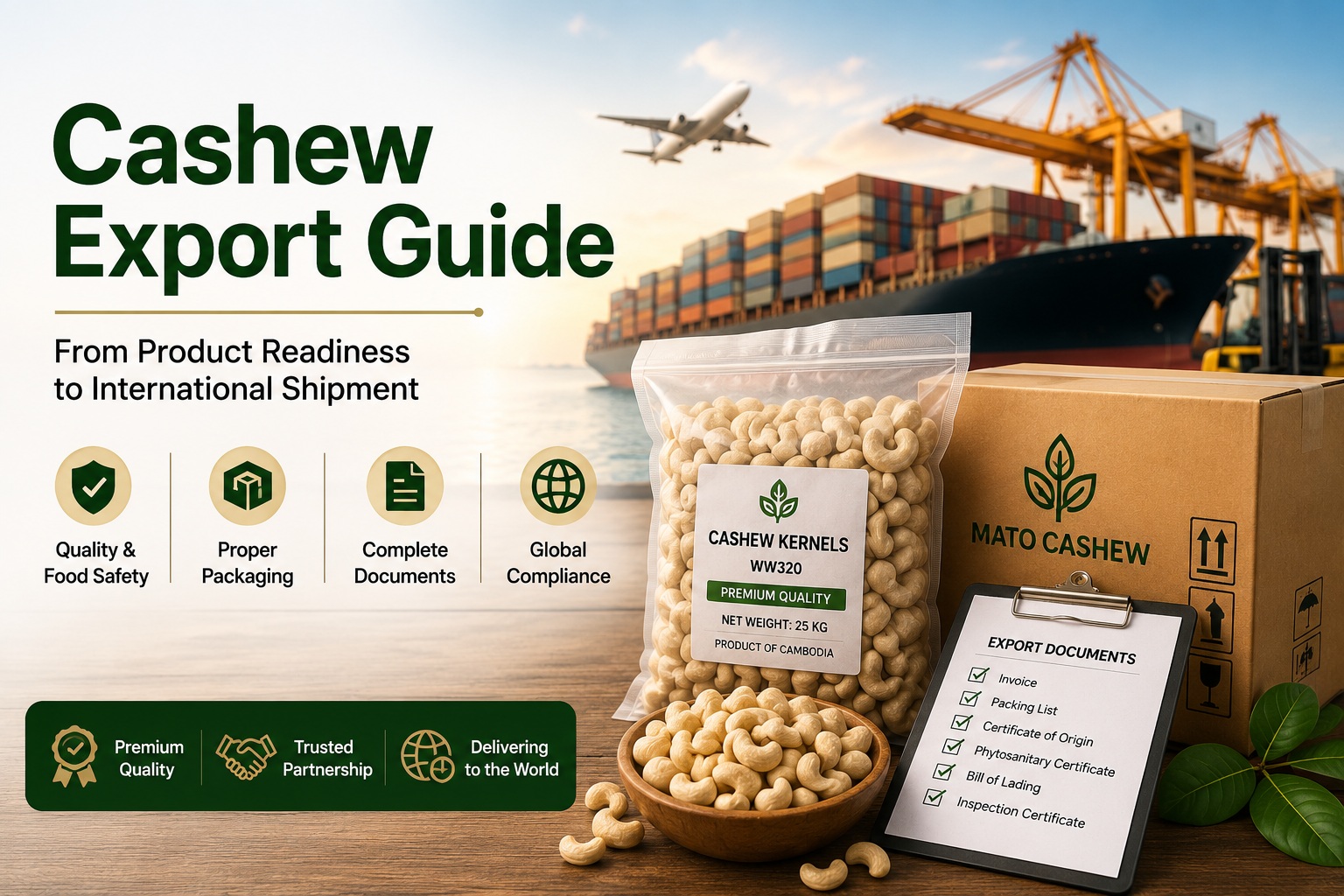
Common Export Document Categories
Instead of treating documents as one universal mandatory list, it is more accurate to organize them by purpose.
| Category | Examples | Typical Responsibility / Source | Applicability |
|---|---|---|---|
| Commercial | Commercial invoice and transaction information | Exporter / seller | Transaction-specific |
| Packing / Lot | Packing information, lot or batch identification | Exporter / packer | Common, but format and detail vary |
| Customs | Export declaration and applicable supporting information | Exporter / declarant with customs | Export-side process |
| Origin | Certificate or evidence of origin | Exporter plus authorized issuer or applicable origin system | Where applicable |
| Plant Health | Phytosanitary certification | Competent plant-health authority | Commodity and destination dependent |
| Transport | Bill of lading, air waybill, or other transport document | Carrier / freight forwarder | Depends on shipment mode |
| Testing / Inspection | Laboratory, inspection, health, or other certificate | Laboratory, inspection body, authority, or other responsible party | Where required by regulation, buyer, or transaction |
This table describes document categories, not a promise that every example is required for every shipment.
Cambodia Export-Side Process
For a Cambodian exporter, customs export procedures form one part of shipment preparation.
At a high level, the process can be understood as:
Prepare shipment and transaction information → Lodge the applicable customs export declaration → Provide applicable supporting documents → Customs processing / clearance → Shipment
Cambodia’s General Department of Customs and Excise administers customs procedures and export declarations. The exact declaration data, supporting documentation, procedure, and clearance requirements should be checked against the current GDCE process for the transaction.
Use Current Cambodia Customs Requirements
This guide provides a high-level export-readiness framework, not instructions for completing each customs declaration field. Verify the current procedure and required supporting documents with Cambodia’s competent authorities and qualified service providers where appropriate.
Certificate of Origin
A Certificate of Origin (C/O) provides evidence concerning the origin of goods. In Cambodia, origin certification can operate in different contexts, including preferential and non-preferential origin.
Preferential Origin
Preferential origin is connected to an applicable trade arrangement and its rules of origin. Where a preferential claim is made, the exporter must consider the relevant agreement, origin criteria, certification mechanism, and supporting evidence.
Non-Preferential Origin
Non-preferential origin serves an origin-certification purpose outside a preferential tariff claim. Its use and documentary requirements depend on the transaction and applicable rules.
Certificate of Origin Is Context-Specific
Do not assume that every cashew shipment requires the same Certificate of Origin or certification method. The applicable form, evidence, issuer or self-certification mechanism, and rules of origin depend on the trade arrangement, destination, transaction, and current requirements.
Phytosanitary Requirements
Plant-health requirements need particular care because they depend on the commodity and destination.
A useful model is:
Commodity Form + Processing Status + Origin + Destination + Current Plant-Health Rules → Applicable Requirement
Raw cashew nuts and processed cashew kernels should therefore not automatically be treated the same.
RCN and Processed Kernels May Have Different Plant-Health Requirements
Do not assume that a phytosanitary certificate is always required—or never required—based only on the word “cashew.”
Destination-Market Requirements
Export clearance from the origin country does not by itself establish that a shipment satisfies every requirement in the destination market.
Destination checks may involve:
- Food-import requirements.
- Importer responsibilities.
- Plant-health controls.
- Customs entry.
- Labeling or marking.
- Contaminant or product limits.
- Notifications, registrations, certificates, or inspections where applicable.
- Product/origin-specific controls.
Two examples show why these layers must remain separate.
United States Example
For U.S. food imports, the FDA food-import framework and the USDA APHIS plant-health framework address different regulatory areas.
Depending on applicability, FDA-related food-import considerations can include facility registration, Prior Notice, and importer-side Foreign Supplier Verification Program responsibilities. Plant-health admissibility and phytosanitary requirements are evaluated separately through USDA APHIS rules.
Processed nuts can fall under plant-product treatment different from less-processed commodities, so the exact commodity should be checked rather than assuming that all cashew forms require identical plant-health documentation.
European Union Example
EU food-import controls also depend on the product, origin, regulatory area, and current risk-control framework.
Food of non-animal origin may be subject to general food requirements and contaminant limits, while certain product/origin combinations may be subject to increased or special controls where applicable.
| Destination Example | Key Concept | What the Exporter Should Avoid Assuming |
|---|---|---|
| United States | Food-import and plant-health requirements operate through different regulatory frameworks | That one FDA or APHIS rule describes every cashew import requirement |
| European Union | Controls can depend on product, origin, contaminant requirements, and current risk measures | That one fixed checklist applies to every cashew shipment entering the EU |
Re-Verify Destination Requirements Before Shipment
Import rules can change. Product/origin combinations can also be treated differently. Use current official destination-market information and coordinate with the buyer/importer, customs broker, competent authority, or other qualified party as appropriate before shipment.
Exporter vs Importer Responsibilities
Understanding who is responsible for each task helps prevent gaps and duplicated work.
| Role | Typical Focus | Examples |
|---|---|---|
| Exporter / Seller | Origin-side product and shipment readiness | Product specification, packaging, export-side documents, customs export process, traceability |
| Buyer / Importer | Destination-side import readiness | Destination import obligations, importer filings, buyer-side verification, market-specific requirements |
| Authorities / Service Providers | Official controls and specialist execution | Customs, plant-health authority, origin issuer, laboratory, inspection body, broker, carrier, forwarder |
The contract, Incoterms or delivery arrangement, local law, and service-provider structure can affect operational responsibilities. Those details should be confirmed for the actual transaction.
Logistics and Shipment
Once the product and compliance requirements are understood, the physical shipment must be arranged.
Important logistics considerations may include:
- Freight mode.
- Carrier or freight forwarder.
- Booking and shipment schedule.
- Transport documentation.
- Container or cargo condition.
- Package protection.
- Loading and handling.
- Transit conditions.
- Insurance where applicable.
- Customs coordination.
- Delivery instructions.
The logistics plan should protect the product rather than undermine the quality achieved during processing, packaging, and storage.
For storage and handling principles before dispatch, see the Cashew Storage Guide.
Traceability and Record Consistency
Traceability becomes especially important when product information moves across several documents and organizations.
A useful consistency chain is:
Product / Lot → Packing Information → Commercial Records → Applicable Certificates / Supporting Documents → Transport Record → Buyer / Import Record
Names, quantities, lot references, weights, product descriptions, marks, and other relevant identifiers should be checked for consistency where they appear across the shipment record.
Good traceability helps parties identify what was shipped, connect it to production and quality records, and investigate discrepancies if they arise.
Pre-Shipment Verification Framework
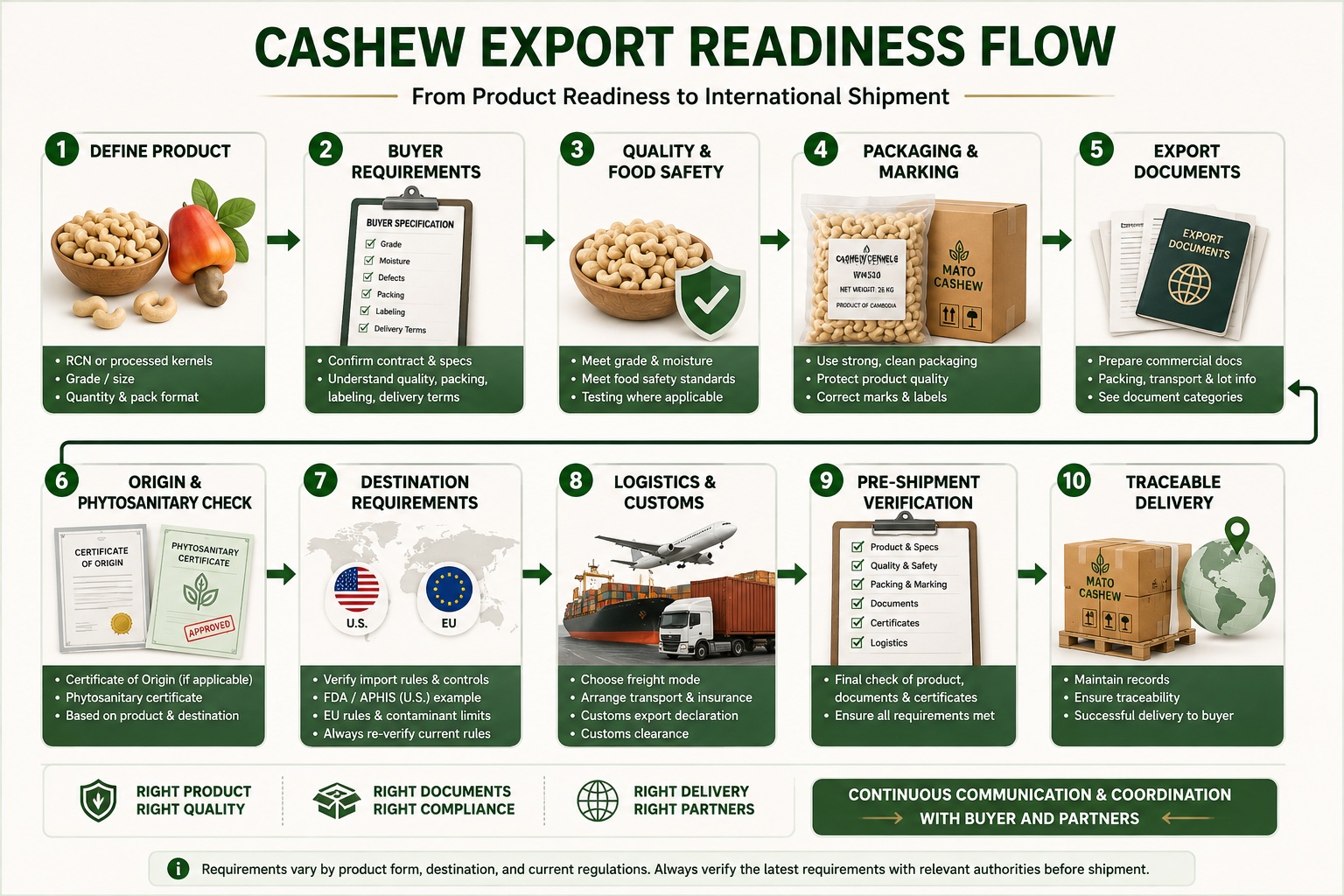
Conceptual cashew export-readiness flow. Actual documents, certificates, filings, and responsibilities depend on the product, origin, buyer, destination, shipment, and current requirements.
Before dispatch, a processor or exporter can use the following as a verification framework:
- Product defined — commodity form, grade, specification, quantity, and lot are clear.
- Buyer requirements confirmed — commercial and technical expectations are agreed.
- Quality and food-safety requirements checked — relevant controls and evidence are ready.
- Packaging and marking checked — package condition, identification, and required marks are appropriate.
- Export-side documents prepared — applicable commercial and customs information is ready.
- Origin requirements checked — C/O or other origin evidence is prepared where applicable.
- Plant-health requirements checked — phytosanitary requirements are verified for the actual commodity and destination.
- Destination requirements verified — current import, food, labeling, or other applicable requirements have been checked.
- Logistics arranged — carrier, freight, customs coordination, and transport documents are organized.
- Traceability records checked — product, lot, packing, document, and shipment information are consistent.
A Verification Framework, Not a Legal Checklist
The steps above help organize export preparation. They do not mean that the same document, certificate, filing, or authority applies to every shipment.
Common Export Mistakes
Common mistakes include:
- Copying one generic document list and treating it as universal.
- Failing to distinguish raw cashew nuts from processed kernels.
- Assuming a phytosanitary certificate is always required for every cashew shipment.
- Assuming the same Certificate of Origin process applies to every transaction.
- Confusing exporter responsibilities with importer responsibilities.
- Meeting a buyer’s grade specification but failing to verify destination requirements.
- Using outdated regulatory information.
- Preparing documents with inconsistent product, lot, quantity, or weight information.
- Ignoring package damage or seal integrity before loading.
- Treating a commercial quality standard as a complete customs or import law.
- Failing to coordinate with the buyer, importer, broker, carrier, or competent authority where their action is required.
Key Takeaways
- ✓Start export preparation by defining the exact cashew product and buyer specification.
- ✓Treat quality, food safety, packaging, documents, origin, plant health, destination rules, logistics, and traceability as connected layers.
- ✓Use document categories instead of assuming one mandatory list applies worldwide.
- ✓Keep raw cashew nuts and processed kernels separate when interpreting plant-health and other commodity-specific requirements.
- ✓Certificate of Origin requirements depend on the applicable origin and trade context.
- ✓Exporter and importer responsibilities should be confirmed for the actual transaction.
- ✓Always re-check current destination and competent-authority requirements before shipment.
Frequently Asked Questions
What does a cashew exporter need to prepare?
Export preparation normally involves defining the product and buyer specification, confirming quality and food-safety requirements, preparing suitable packaging and shipment information, checking applicable export-side documents, origin and plant-health requirements, verifying destination rules, arranging logistics, and maintaining traceability. The exact requirements depend on the actual transaction.
Are export documents the same for every cashew shipment?
No. Document requirements can differ according to product form, origin, destination, buyer, trade arrangement, transport mode, and current regulation. A document used for one shipment should not automatically be treated as mandatory for every shipment.
Does every cashew shipment need a Certificate of Origin?
Do not assume one universal requirement. The applicable origin evidence or certification method depends on the transaction, destination, trade arrangement, rules of origin, and current requirements.
Does every cashew shipment need a phytosanitary certificate?
Not necessarily. Plant-health requirements depend on the commodity form, processing status, origin, destination, and current plant-health rules. Raw cashew nuts and processed kernels should be checked separately.
Are raw cashew nuts and processed kernels treated the same for export?
They should not automatically be treated the same. Their processing status and commodity characteristics can affect commercial, plant-health, food, and destination-market requirements.
What is the exporter responsible for?
Typical exporter-side work can include product readiness, buyer specification, packaging and marking, export-side documentation, customs export procedures, shipment coordination, and traceability. The exact allocation of responsibilities depends on the transaction and applicable rules.
What is the importer responsible for?
The importer commonly handles or coordinates destination-side import obligations, filings, verification, customs entry, and other market-specific responsibilities where applicable. Responsibilities should be confirmed for the actual transaction.
What should be checked before shipping cashews to the United States?
Check current U.S. food-import requirements and the separate plant-health requirements applicable to the actual cashew product. FDA and USDA APHIS address different regulatory areas, and importer-side responsibilities may also apply.
What should be checked before shipping cashews to the European Union?
Verify current EU and destination-member-state requirements relevant to the product, including applicable food rules, contaminant limits, labeling or documentation requirements, and any product/origin-specific official controls.
Why should destination requirements be checked again before shipment?
Regulations and risk-control measures can change, and requirements may depend on the product and origin. Re-checking current official information reduces the risk of relying on an outdated general guide.
What information should be consistent across export records?
Where applicable, product description, lot or batch identification, grade, quantity, weight, package information, origin, and other shipment identifiers should be checked for consistency across commercial, packing, certification, and transport records.
Can this guide replace a customs broker, importer, or competent authority?
No. This guide is an educational export-readiness framework. Actual compliance and shipment procedures should be verified with current official sources and the relevant importer, customs broker, competent authority, or qualified service provider as appropriate.